
DOWN MEMORY LANE
A HISTORY OF OUR FAMILY AS RECALLED BY THOMAS W. REED (Formerly Weiszbluth Gyozo Tamas, Thomas Weiszbluth and Thomas Weissbluth)
Its 2006 and I am 77 years old, married for 53 years to my wonderful wife with whom I am very much in love, former Lora Alpert Gold, and I want to write this book for my living descendents and generations to come. Please note that the hero of our history is undisputedly my father, Eugene Weissbluth, formerly Weiszbluth Jakab (generally known as Weiszbluth Jeno), who not only saved my life against all odds, but also did everything humanly possible to give me an opportunity for a higher education and through me re-established our decimated family. The details of these introductory statements will reveal themselves in the pages of this book.
FAMILY BACKGROUND
My immediate family in 1944, on the eve of the Holocaust, consisted of my father, Eugene Weissbluth (aka. Weiszbluth Jakab in Hungary, with the Hebrew name “Jankev”), my mother Rozsa (maiden name Rosenblum, her Hebrew name was “Rachel”, I was Weiszbluth Gyozo Tamas, nicknamed “Tomi”, with the Hebrew name of “Avrohom”. My brothers were Gyorgy Tivadar (“Gyuri” and with the Hebrew name of “Menachem Mendel”), Oscar Ivan (“Oszi” and with the Hebrew name of “Arye Leib”) and Alfred Denes (Fredi and his Hebrew name was “Eliezer Zvi “). My little sister was Judith (Juditka and her Hebrew name was “Keile” and her nick name “Mucus”). Juditka was a blue and blond little girl. Younger brother Oszi, Juditka and I had our father’s blue eyes. I was the oldest of the children and in 1944, at the start of our tragedy; I was only 12 years old. My siblings were aged in descending order, 10, 8, 6 and 4 years old. My mother was a pretty lady, talented amateur painter, pianist, housewife and courageous woman. My father was the principal and a teacher of the Jewish elementary and middle school (combined duration eight years) in our town of residence, Mezocsat, Hungary. He also taught German to private students and part of the year, he taught in the agricultural school. My father was always deeply involved in helping individuals with problems in the Jewish community and frequently represented parties in front of the rabbi’s court. On a number of occasions in the ”old days” he was “second” for dueling Christian friends.
My grandfather on my father’s side was Josef Israel Narcisenfeld (Yechiel ben Simon) married to Golda bas Avrohom. They had a set of twins that died at birth and their oldest was Lajos (Louis) Kiss followed by my father. Uncle Lajos had married twice and had a son Dezso (David) from his first wife. The reason for the differences in last name was related to my grandparent’s citizenship problems that had to be covered up by bribing a government official to avoid deportation and subsequent murder of those deported. This was the fate of 17,000 Jews deported from Hungary in 1941. My father took out a loan to obtain false papers that worked. My mother has discovered the loan after my father was drafted and no payments were made on the loan. My father would not talk to me about it all, except that my grandfather was born in Munkacs that is in now Rumania. A “man”, a jerk, in our community, to belittle us, told me that we were originally from Poland. Being from Poland was considered shameful. Regarding my Uncle Louis, he had proposed marriage to the girl who became his first wife and David’s mother. Actually he wanted to break the engagement, but my grandparents would not permit it. They told him that he could not shame a decent girl by such action. Later he divorced her and remarried.
My grandparents on my mother’s side were Armin and Tini Rosenbloom and they had two sons and five daughters. All of my life, I only remember meeting my maternal grandfather once and my maternal grandmother twice. The first occasion was when my father was discharged from the Hungarian Army and picked up Gyuri and me from the home of my Mother’s oldest sister, Blanca, in Rohod. The second time I saw my Grandmother was when she came to visit us in Mezocsat. Upon arrival she gave each of us a “pengo”, which looked like a silver dollar). A few days later she “borrowed” it back for good. To our amazement, she found and visited a woman who was a fortune teller and she enjoyed making an drinking “tea” from our poppy seed plants-the part that held the seeds we that we had ground for our Saturday morning poppy seed cakes. Apparently she suffered from high blood pressure that those days could not be treated. After a few days she started saying she was going to die and we had to send her home to Sarospotak. The Rosenblum home was located on a main street. I remember the grand piano and numerous unfinished oil paintings left by my mother and her sister, Etus. While in Sarospotak, we met briefly with with my Uncle Jeno, Aunt Dora Rosenblum, amd their son, Gabe (father of Karen “Rosie” Rosenblum Stafford). We visited the “Rosenblum and Son” lumberyard, which occupied all of the land across from the railroad station. We also went to visit Aunt Margit at Satorajaujhel (she was the youngest of the Rosenblum girls) and her two little sons. She was married to a Silberman, who at the time was serving as a laborer in the Hungarian Army. She had to run their hardware store located on the street leading to the railroad.
She did not approve of any of her son in laws, but my father “bribed” her with books since she was a voracious reader.
As you can imagine, managing five healthy kids was not easy for my parents, especially me, who was always up to something. I liked climbing up on the roof, dismantled my mother’s only clock, taking down the electrical wire between our two buildings, did not want to pray, tried to skip attending the Temple, studying the Bible etc. Thus, I was a difficult child who had to be spanked and exiled to the corner frequently. Compared to me, my siblings were angels. I loved to read and play with other kids of my age. I think that I wanted a more modern environment than was available to me. Might as well remember that you are my descendants!
My friend Joe Gajducsek and I snuck behind his Aunt’s outhouse to smoke a “levant” cigarette that resulted in lots of coughing and no pleasure. One Friday, Joe and I went to the ritual bath (the “Mikveh”) early in the day and found a long wooden washtub floating in the water. Lo and behold, we had boat! We jumped in and happily paddled around until Mr. Daskal, who also took care of the Mikveh, happened by and was shocked to see us paddling around in the tub that was used to wash the community’s dead prior to burial.
One warm day, while attending Torah classes, my teacher, Mr. Friedman nodded off to sleep while we took turns reading out loud. Being the unruly child that was, I melted red sealing wax onto his beard, thus gluing him to the table. I obtained the wax from my friend Shaje Krauss, whose father used it in his wine business to seal bottles of kosher wine. Upon waking, Mr. Friedman tried to sit up but his beard would not move. His eyes widened when he realized his predicament. To make long story short, most of his beard had to be cut off and I was spanked very hard, Actually, I am not proud of what I did but I was a very bored and mischievous boy.
We had an outhouse at our home in Mezocsat. At night, the house was locked up and we used night pots, which we routinely emptied int he morning. One night, foursome reason, rather than use the night pot, I peed in the maid’s shoe. I only did it once as I received a hard spanking for my actions.
The Jewish community was established in about 1828 as a very strict Orthodox congregation. A Temple was built that eventually burnt down, only to be replaced by an impressive two story building. Who we visited it was in a state of semi-ruin, because of a lack of maintenance since 1944. The town of Mezocsat “owned” the building and had rented it out as a warehouse and the tenant destroyed the interior and failed to maintain the windows, stucco exterior and roof. Since that time, The Temple has been restored by the town and is now used as a community center. It was a well established community with about a dozen non-religious families who also had to pay the community “religion tax”. Except for a Christian owned corporation called “Hangya” (ant) that owned several stores, established to compete with Jewish owned businesses, all stores and enterprises were owned by Jews. Grocery and hardware stores was Glattstein (we shopped there almost exclusively), Friedmann, Saros, Breier, Beck, Droth and others. Clothing material by the yard (not clothing) stores were owned by Carl Roth, who also sold shoes, Friedlander (who was also the President of the community and died a few days prior to our being deported), Saubermann and others. Sirmer and Heinfeld each owned a lumberyard. Mr. Krausz (his son, Siu, was a friend of mine) made and sold wine. Mr. Mehrer sold and repaired radios. Mr. Ferenczi sold and repaired large clocks and we actually stayed in one small room in his house during our few weeks of stay in the ghetto in Mezocsat. Mr. Stiller was a shoe maker, and Messers Szaz and Mehrer made and delivered soda water. Mr. Loebel was one of two pharmacists in town (later the Christian license holder, Mr. Orosz took the business from him). Farm owners included Szekulsz, Resovszki, Borgida, Winkler and others. Attorneys were Dr. Furesz, Dr. Goecze and Dr. Bergmann (he survived the Holocaust and become a Judge, first in Mezocsat and later to a higher court located in Miskolc. His son Tibi was a friend of mine. The only dentist in Mezocsat was Dr. Kardos, who was also physician. The other physician was Dr. Abonyi and the veterinarian was Dr. Winkler. Mr. Kolozs owned the only mill and his wife survived. Mr. Engel owned the only bank (his son, Laci, married a Christian woman and he and his children escaped deportation. Laci’s sister survived the concentration camp but as a result of her experiences, had mental problems. There were several grain dealers town as well. Our Rabbi was Fabian Altman, whose son “Schema” was a classmate of mine. The had cantor and also one of the two ritual slaughterers (the “schochet”) was Mr. Cohen and the second was Mr. Daskal (He also took care of the ritual bath or “Mikveh”. His son, Mayer, was my Hebrew teacher starting when I was three years old and my long blond hair was cut off. Mayer ended up in Cleveland, Ohio and become the owner of several large nursing homes. Shagra Neumann, a wonderful individual (who also survived the Holocaust and ended up in Israel) eventually replaced Mayer. Mr. Friedman and later his son in law, Mr. Berkowitz, taught religion (reading the Torah) in Hungarian language at my father’s school. It was interesting that the Orthodox community did everything they could to prevent Zionist youth from departing to Israel while the escape routes were still open. The generally strong anti-Zionist views of the Orhodox views was well known.
As a child, I had a nice life. The first thing I remember is that I was in part of our yard that was covered ingress and the son of the only blacksmith in Mezocsat, wearing a jacket with red vertical, blue and white colored stripes lifted me on his back. My parents told me that I truly scared them when I, as a very small boy, took my brother George out of his crib and carried him out the tiled patio although I have no memory of having done so. I was enrolled in a non-denominational Kinder Garden but I did not adjust well to being away from home and as a result, my parents removed me from the situation. When I started school, we mostly played with Jewish kids and our Christian neighbors. Our most fun was playing “hide and seek” in our peasant neighbor’s yard with its large gardens, straw stacks, hay stacks and many auxiliary buildings. In the summer we very much enjoyed our metal bath tub in our yard, heated by the sun. We bathed naked along without usual guest, Anni Hoffman, who survived the Holocaust along with Zoka Landsman and a friend of mine, Joe Gajducsek. My parents loved to read and they had a 2000 volume library that was acquired with part of my mother’s dowery. There was a night light that was in use every night except Fridays. I also loved to read laying on the floor. I even had my own library, having read the Hungarian classics by age twelve in Hungary.
The Zionist youth was to wait until the coming on the Messiah before going to Israel. I even witnessed fistfights in my own community of Mezocsat in the Temple and the Temple yard to prevent he religious Zionist “Augudas Yisroel” youth organization from having a Torah to use in their Orthodox religious services.
While on vacation in Rohod visiting the Gruenwald family, my Aunt Blanca enrolled me in “cheder” to study Torah each day. This consisted of reading the weekly Torah portion in Hebrew and translating it into Yiddish. Since I did not speak Hebrew or Yiddish, did not like the Melamed or have any interest in studying Torah, my hand had many painful meetings with the Melamed’s (teacher) wooden stick. The cheder was held in a building that had previously been a tavern with a space below the floor used to keep the alcohol reasonably cool. One day I convinced my fellow students to play hide and seek anti lthe Melamed got there. As I expected, they all hid in the below the floor cavity and I locked the trap door. When the Melamed arrived I met him outside and told him that since I was the only one in attendance, we should go home. By then the other kids realized that I had locked them in the and started banging on the trap door. The Melamed heard the knocking and let them out-I knew I was going to get a whipping so I jumped on the table and out the open window and ran through the unfenced gardens towards “home” with the Melamed chasing me. Aunt Blanca had mercy on me and I no longer had to go to cheder.
Just before my father was discharged from the Hungarian Army, my mother took Gyuri and me to the home of her older sister, Blanca Gruenwald, in Rohod, for a vacation. We had to change trains in Miskolc and then in Nyireghaza to go to the Baja-Rohod station, Rohod, a small village without electricity, was the home of the Gruenwald side of the family. The train stopped at the Village of Vaja and a number of miles from Rohod. During our required layover in Nyiregyhaza we visited a cousin in of my mother and ate dinner at their kosher delicatessen. Upon arrival in the dark at the Baja-Rohod station we waited in vain for at least an hour for the buggy to come for us. After that we walked into Vaja and knocked on the window of a peasant’s house and asked for a bed to sleep in. They vacated one of their already slept in beds and all three of us slept in it. The next day word went out to the Gruenwald family as to what happened and a buggy was sent for us but it arrived so late that we were not able to depart until the following day. We had wonderful vacation. My cousin Hersu (Herman) was very interested into young ladies who were visiting at the same time so we saw little of him. We did however get to spend lots of time with Potyi and Alice, who were both wonderful. Uncle Toni and Aunt Blanca could not have treated us any more nicely either. Uncle Toni took us to his farm where he grew wheat and tobacco. The tobacco was dried in large ventilated barns. The workers and their families lived on the farm. The workers smoked dried tobacco cut with their pocket knifes and wrapped in newspaper to make cigarettes. When it was time to deliver the wheat to the railroad station in Vaja, I rode on the last wagon to make sure the farm hands did not drop any bags over the side if the wagons and into the ditches to be picked up later.
The Hungarian Army was destroyed by Russia at Stalingrad and the remnants retreated to Hungary. Upon the return to Hungary via a long march, they were discharged. My father immediately contacted the government education officials to collect his back pay. The officials told the community that the payments their responsibility and that if they did not pay up, the government would seize the “gabela” (the money collected for the kosher killing of animals) by both of the kosher butchers (Mr. Cohen and Mr. Daskal).
Then my father took Gyuri and me home via a visit to our Rosenblum grandparents and my Uncle Jeno and family (Aunt Dora and cousin Gabe) in Sarospotak. We then visited Aunt Margit (Margaret Silberman). Aunt Margit’s husband was still away serving as a forced laborer. At Sarospotak I met the above persons for the very first time except my grandmother who visited us in Mezocsat. This was also the last time I oversaw them again. To be with our father was the most happy we could be after his absence.
My Mother has a live in maid after each of her pregnancies and at least after Freddy was born, my cousin Edith came to help us. My Mothers like was hard in that with the exception of short periods of time, she had to do EVERYTHING for the family, including cooking, washing clothes and children, mending socks, planting and harvesting the garden, feeding the poultry, planting flowers and watering the flowers and vegetables. The children helped whenever and however they could-they watered the plants, got milk from the neighbor (Mrs. Torok), made butter, got water from the well, took the poultry to the kosher butcher, took cholent to and from the baker, ran errands, etc. To fertilize our garden, we had our neighbors spread raw manure mixed with straw and we spaded that into the ground. After planting, we hoed the ground around the growing plants although my father and the very young children were exempted from this work. Mother knew exactly what to do and when. The plantings generally consisted of potatoes, corn and many different vegetables. Yearly rotation between the potatoes and the corn planted areas was performed. When the potatoes started growing, we dug under the plants and took some of the young potatoes for cooking. We had both red and black berries, mulberry (buske) and currant (ribizly) bushes along the edges of the garden. The neighbor had “ever” trees and their fruits were always available to us. In 1942 we we had about a dozen dwarf fruit trees planted in the garden. They had some fruit on them by 1944 but according to Jewish law, we could not eat them until they were three years old and by then we were deported to Auschwitz. When I visited Mezocsat in the late 1990’s with my wife, son, daughter in law and grandson Alex, they were already gone. However, I did find some “buske” bushes and enjoyed their fruit very much. Our water came from a well located outside our winter kitchen. We used a bucket lowered with a solid lead counter weight balanced by another rod that went through ha “v” shaped tree with weights at the dar end of it. The water always had things floating in ti that we spilled out onto the ground. We never washed our fruit and drunk the well water without any ill effects.
The menus changed with the season and depended on what grew in the garden, what was available in the outdoor market (piac). and what the extensive results of my Mothers canning. Our weekday menu focused on my Mothers baked rye bread for toast, the butter made, jams/lekvar and chicory coffee with sugar and milk for breakfast. Our main meal was lunch and it was based on a hearty vegetable soup along with bread and jam/lekvar. Dinners were similar to breakfast-scrambled eggs fresh from our chickens, were frequently added to either lunch or dinner. We always had bread, jam/lekvar and goose liver available to us. The house had a summer and a winter kitchen. Fresh fruits, vegetables along with melons were all available to us, depending on the season.
Friday night meals were special. They consisted of Challah, chopped chicken liver, chicken soup with chicken feet along with unlaid eggs (yellow balls), stuffed chicken and nickel. Saturday morning we had delicious cakes with an array of fillings, including ground poppy seed dmixedwith powdered sugar and coffee. The lunch was sometimes coolant with dumplings-they were varied and more extensive than I am describing here but I cannot recall the details now.
Our clothing was always appropriate for our age and style in fashion. My father and mother were eloquent dressers-handmade by a tailor or dresser as applicable. We always damaged the toes of our shoes by playing soccer. Wearing overshoes was necessary when it rained hard or snowed since with the exception of the Main Street, none of the roads were paved. I slept with my brother Gyuri on a “divan” (a day bed) and while the bedroom oven was seldom used.
The World War II deportations resulted in almost 500 deaths in my community by gassing and other inhuman ways, including starvation, being worked to death, being beaten to death, being shot, exposure to the weather, forced marches, torture, so-called “medical experiments” and frequently, children and old people were burned alive at Auschwitz. The very few people from Mezocsat who survived the camps returned only temporarily to Mezocsat as I was only aware of four people who stayed there. My wonderful cousin Edith went to Mezocsat to gather what might have been left of our belongings. There was nothing left except what my Mother left with Mrs. Farkas Oliver, a wonderful lady and an ex-neighbor from when my parents lived in Mr. Barany’s house. She returned to Edith my Mother’s diamond engagement ring (a one carat diamond), her silver purse and my father’s gold watch chain. My Father sold the watch chain, gave the diamond ring to my step mother Trudy who unfortunately left it out when a burglar broke into our apartment on Eddy Road in Cleveland Ohio and stole it and I gave my daughter Judy my Mother’s silver purse for use by her daughter, Saree. The fact is that the deportation of the Jews of Mezocsat destroyed the Jewish community of Mezocsat and only the ruined temple and cemetery remain. The only Jew left left when we visited as a family was these of a survivor who is married to a Christian, No one that I know of in the Christian community stood up for us. Therefore, without exception, seeing or even thinking of Mezocsat and its people make me sick. They only thing they did not do was to desecrate our cemetery, probably because there is no profit in it. One Jewish survivor, upon returning to the town without his family, killed himself. What was there to go back to and live among people who in general hated is and happily plundered our hard earned belongings?
Although there was always antisemitism in our region but it only got worse as the barraged. My brother and I were threatened by a young man with a knife. When my Mother complained to the Police she was told that there was nothing they could do. In March of 1944, Germany occupied Hungary, in part out of fear that Hungary was conducting secret talks with the Americans. In April of 1944, the order to remove 437,000 Jews from from provincial towns villages and cities (other than Budapest) was issued by Adolph Eichmann. As bad as the Nazi’s were, part of the horror was that the deportation orders were faithfully carried out by Hungarian officials, led by the Hungarian police. Without the eager cooperation of the Hungarians this and the deportation to Auschwitz would not have happened. Amazingly, there were less than one hundred Germans assigned the task. The Hungarian agent government carried out these tasks eagerly, in many cases, with cruelty and they handed over the entrained Jews to the Germans for destruction in Auschwitz. From their homes, the Jews were forced into local ghettos and then assembly areas and then to Auschwitz. There w s essentially no protest against these actions any the Hungarian people. The Christian Churches did save some Jews who had Christian spouses. We were forced out of our homes in Mezocsat and made to report to an area of town. We were forced to walk to the railroad station where we were roughly placed in cattle cars which were very crowed and unsanitary. People begged the Hungarians for water as we sat in the cattle cars. We were taken from Mezocsat to a brickyard in the town of Diosgy, near Miskolc. We spent several weeks in the brickyard which served as a regional gathering place for deported Jews. There was no privacy and no separation of families. All of us used an open trench as the bathroom.
After the war, some Jews wanted to return to their homes. Unfortunately, there were no laws passed regarding the return of Jewish property and there were programs in some cities and villages where returning Jews were killed. These programs occurred in Kunmadaras, Miskolc and other communities. My father wanted to return to Mezocsat and rebuild our lives and I wanted to emigrate to the United States. My Father finally agreed and we started the paperwork process. In order to emigrate, not only did we have to have the necessary paperwork prepared and background checks performed, we had to wait until we fit within the quota of Jews allowed in and we had to have a sponsor who would guaranty that we would not become a financial burden on the government. My father had distant relative who was an accountant in Cleveland Ohio and he was part of a small congregation in search of a Rabbi. As an aside, my father came from a long line of Rabbis-One of his ancestors, a Rabbi, was the chief judge in the Court of the “wonder rabbi or Satorajaujhel and is buried in a local cemetery. While being a Judge, a woman came before the Court claiming that a ghost had impregnated her. Superstition about ghost (“shedem”) who could impersonate people and impregnate women were believe in by a segment of Jewish society. That same ancestor’s son visited the city regularly on the anniversary of his father’s death and to say Kaddish at at his grave. He usually stayed overnight in the City and left the next day. However, on one occasion, his father appeared to him and told him that he “was very lonely”. The son got scared and left the city, never again spending the night there. In 1949 we were finally told that we could leave Germany and go to our new home-The United States of America. Finally, we were on the U.S. General Ballau headed to the US. We went through Ellis Island on June 17, 1949, having traveled on the U.S.S. General Ballau and were greeted by Gertrude Guttman (who became my Father’s second wife). We spent only a few weeks in New York before departing for Cleveland. I was fortunate because Gertrude had helped me learn English while we were in Feldafing so I could speak some of the language. My father went to work as the Rabbi and we worked factory jobs to help make ends meet. We rented a room where we shared a bed and had kitchen privileges. We wore blue jeans when the only others who did so were farmers and we were hard pressed to even afford toothpaste. My father knew that I needed to continue my interrupted education. He obtained or perhaps prepared forged documents stating that I had graduated from high school. I was admitted to college, barely able to speak English, and studied engineering. I was asked to join a fraternity but declined to do so as I needed to focus on my studies. My father sold part of his stamp collection to help me with my college fees and through his hard work and sacrifice, and then later the GI Bill, I was able to not only finish college but later attend law school at night while working 48 hours a week as an Engineer at what was then North American Aviation, which later became Rockwell International and ultimately, Boeing.
While pledging a fraternity during September of 1950, I went on a triple date and met my future wife, Lora. She was the date of a fellow wo later become one of my best friends. While on leave from the Army, Tom met Lora again at Hillel and a romance bloomed immediately. After I left the Army, Lora and I got engaged and on September __, 1955, (Labor Day), against all sensible advice, we got married. Lora quit her studies after finishing her junior year as a biology major at Western Reserve and became the Biology Department’s Librarian. By the time I received my B.S. in Electrical Engineering, I had received 16 job offers and accepted a position with North American Aviation, Columbus Division. We moved to Columbus, Ohio and Lora changed her major to American History. Our first child, Mike, was born August 8, 1956 and I started law school at Franklin University (now Capital University). Lora received her B.A. and continued on for a B.S. My LLB was replaced by a JD. When I graduated from college I was fortunate enough to marry my college sweetheart-my “Hillel girl”. My father asked us to come over and receive a special blessing from his Rabbi the week before our marriage. It turned out that my Orthodox father did not believe that we would really be married in the eyes of God if we were married by a Reform Rabbi so he had his Orthodox Rabbi marry us in a Jewish ceremony without our knowledge.
One of my father’s primary goals in life was to recreate our decimated family and I was thrilled that my father lived long enough see our family well on the road to recovery. He loved and sacrificed for his grandchildren, buying each an insurance policy that would pay off when they were teenagers. Every visit with him meant a visit the story to buy grocery bags of candy and of course, sugar free gum for the grandkids and Brach’s chocolate covered cherries for my wife. He was also very much in love with his great grandchildren.
HUNGARY
Jews lived in Hungary for 1900 years, from the time of the Roman Province Pannonia. Within this province the Jews lived in a number of places in what is now known as Hungary. These places include Aquincum (Budapest), Solva (Esztergom), Sopianec (Pecs). This fact is clearly demonstrated by the remains of old synagogues, ritual baths, head stones and other items displayed in museums, such as the Vari Museum in Budapest. In the late 800 AD, seven Asian pagan tribes from Asia united and took over the area that is basically known as Hungary. The tribes were excellent mounted fighters and mainly lived from plundering the Western European Christian countries, including France, Italy and Germany. In 998 AD the tribes were severely defeated by a Germanic King named Otto, near Augsburg, Germany, as they were trying to cross the Danube with their plunder. Subsequently, the tribes withdrew to the general territory now known as Hungary and elected a tribal leader, Stefan, as their king, to seek peace with the Western European countries. King Stefan, who later was known as Saint Steven (aka. St. Stephan), sent a delegation to the powerful Pope of the Holly Roman Empire requesting permission to settle down in peace on their occupied territory in exchange for converting to Christianity. The Pope agreed and sent Steven a crown and missionaries to Christianize the tribes. Steven ordained that no person shall be “forced” to covert, but those who do not will be buried alive. After a number of missionaries were slain, including Saint Gelert after whom a hill is named in Budapest. The tribes became Christian and their area became known as Hungary. Subsequently Steven was ordained Saint by the pope. His supposed right hand is a religious relic that is paraded on Saint Steven’s day in Budapest.
Noteworthy that Hungary had two categories of police, namely one for the cities called ”rendor” (order guard) police and one for the rest of the country called “csendor” (quietness guard) police. Mezocsat had “csendors” who were primarily trained to deal with peasants and they were rough individuals. The two categories wore different uniform and carried different weapons. After WWII because of the csendors shameful dealing with the deportation of Jews and their associated crimes their organization was merged into that of rendors.
JEWISH LIFE IN HUNGARY
In the later part of the 9th century, the Jews in the Asian said Roman provinces along with other natives, came under the conquering barbarian tribes, led by a leading chieftain named Arpad. The Jewish community, being relatively very well educated and useful to the barbarians, has greatly expanded in the 11th century through immigration from Germany, Bohemia and Moravia. In 1092, restrictions were placed on the Jewish community, the Christian clergyforbid intermarriage, owning slaves and working on Sundays and Christian holidays. At the end of the century King Kalman placed special taxes on the Jewish community in payment for protection. However, by the end of the 12th century Jews held leadership positions in the country’s economic institutions. Subsequently, in 1251, King Bela gave the Jews legal rights and welcomed Jewish immigration. Unfortunately, the influence of the Christian church greatly expanded under King Louise (1342-1382) and in 1349 the Jews were expelled from Hungary for being accused of causing the Black Death. Than, starting in 1364 Jews were permitted to return.
The situation for the Jewish community has improved under Matthias Corvinus (1458) also known as King Matyas. Once again the economic and political situation deteriorated, resulting in of 16 Jews being burned at stake. Other riots also occurred. King Ladislas (Laszlo) cancelled all debts owned to Jews. During the subsequent reign of Louis II (1516-1526) the anti-Semitic feeling grew even stronger. Following the Ottoman conquest of a large part of Hungary in 1526 many Jews joined the Turks to migrate into the Ottoman Empire. This led to the dispersion of Hungarian Jews into the Balkan region. In 1541 central Hungary became an official part of the Moslem Ottoman Empire and Jews were once again allowed to practice their religion and participate in commerce.
In the late 17th century the Hapsburgs “liberated” Hungary, kept it part of their conquered territories and anti-Semitism resulted in expulsion of Jews from the cities. Despite of all this immigration of Jews grew from Poland and Moravia where the situation there for the Jews must have been worse. By 1735 about 11,600 Jews lived in Hungary. However, situation for the Hungarian Jews became even worse under the reign of Maria Theresa (1740-1780) the Jews were forced to pay “toleration” taxes and faced other persecutions. Regardless of all these, by 1887 about 81,000 Jews lived in Hungary. Subsequently, under Joseph II the harsh conditions were finally reduced and Jews were granted civil rights in 1830 and also Jews were permitted to settle in a selected number larger towns in 1840.
In 1849 Jews participated in a failed revolution against the Hapsburgs and in retaliation again judicial and economic restriction were placed on them during the 1850’s, which were finally lifted in the 1860’s. In December 1867 Jews were granted full emancipation. Thereafter, Jews began playing a vital role in agriculture, transport, communication industries, business, finance and the arts. The Jewish population continued to increase from 340 in 1850 to 542,000 in 1869. The Jewish religion was fully recognized by the state and given the same rights as the Protestant and Catholic religions. Yet, anti-Semitism has increased in the 1870’s and 1880’s. A blood libel trial took place in Tiszaeszlar in 1892. Dessspite of all the Jewish population has increased to 910.000 by 1910 in Greater Hungary that was subdivided after WWI under the Trianon Treaty. Jews became 55 to 60 % of all Hungarian merchants. In World War I (WWI) 10,000 Jewish soldiers lost their lives in the Austrian-Hungarian Army on the Eastern Front. My uncle Louis was a first lieutenant and received a silver star for rescuing a supply train from Russian attack. He contacted malaria that has reoccurred after the war and his heart could not take the induced fever that was the accepted cure. He is buried in the Jewish Avas cemetery in Miskolc.
The strong prevailing religious trend of the Jewish communites was toward strict orthodoxy, but enlightenment came to the Hungarian cities in the form of reform movement (Haskalah). The late 19th century, 1869-1870, was marked by a religious schism. This resulted in three main divisions: Orthodox, Neolog (Reform/Conservative) and Status Quo Ante (not associated with Orthodoxy or Neology). Assimilation became wide spread and especially many young Jews began to inter marrying and conversions were relatively frequent. By 1944 there were 100,000 Christians designated as Jews under the racial laws of Hungary.
The allies at the end of World War I (WWI) dissolved the Austrian-Hungarian empire and Hungary became independent, but under the Trianon Treaty lost a very significant part of its territory and population to the neighboring states. The remaining Jews lost their importance in that their votes was no longer required to prove to the Austrians that the Hungarians were a majority in their claimed territory. Unfortunately, a communist regime gained power with many Jews active in the upper echelon of the government, headed by a Jewish man, named Bela Kun. In 1919 the brief Hungarian-Soviet Republic ended and was followed by a series riots and violence against the Jewish communities, known as the “White Terror”. More than 3,000 Jews were massacred. By 1920 the political situation stabilized and the violence abated, but the anti Jewish sentiment did not wane. A law (“Numerous Clauses”) was passed reducing Jewish access to higher education to 5%. However, some regional universities did not strictly observe said law. A Jewish community fund was established to help Jewish student to study abroad. Anti Jewish legislation continued in the 1930’s. In 1938 the “first Jewish law” was passed, restricting the number of Jews in liberal professions, administration and commerce to twenty percent. In 1939 under a “second Jewish law” the 20% was reduced to 5% and altogether 250,000 Jews lost their source of income. As a result thousands of Jews converted to Christianity. To combat the loss of work and poverty the Jewish community has established a social aid program. Over half of the Jewish population moved to the “greater Budapest area”.
Hungary joined the Axis powers in World War II and as a reward was permitted to reoccupy parts of their post WWI lost territories from Slovakia, Transylvania, Yugoslavia, and Sub-Carpathian Ruthenia. As a result of these the Hungarian Jewish population has increased to 800,000 in 1941. In addition to this there were up to 100,000 coverts including their descendents. Also in 1941, 23,000 Hungarian Jews who could not prove their citizenship were transported by the Hungarians to the German occupied part of Russia and shot by the Germans.
A “Third Jewish Law” was passed prohibiting intermarriage and changing the definition of a Jew to racial definition. Thus, the converted Jews and their descendents, estimated 50,000 to 100,00 became Jews again. Thus, the estimated number of Jews in Hungary became 850,000. A massacre of Jews took place in July 1941 when 20,000 Hungarian Jews were expelled from the Galicia region of Kamentes-Podolski to be murdered by Hungarian troops and German SS. Another massacre of 1,000 Jews took place in Hungary’s Bacska region carried out by Hungarian troops and police units in January 1942. Further, in WWII while serving in the Second Hungarian Army as laborers 50,000 Jews men died on the Eastern Front. MY FATHER, EUGENE WEISSBLUTH, WAS ALSO DRAFTED IN 1941 INTO A LABOR UNIT (AFTER A LONG FORCED MARCH WITH THE REMENANT OF THE DEFEATED 2ND HUNGARIAN ARMY) MANAGED TO GET HOME FROM RUSSIA IN 1943. Also, as described above, 23,000 Hungarian Jews who could not prove their citizenship were handed over to Germans who shot them in the occupied part of Russia. My father’s parents escaped this fate because my father purchased for them fake citizenship papers. They were later killed in Auschwitz.
In 1942, Miklos Kallas, prime minister, ordered a large segment of Jewish property to be appropriated and proposed a “ final solution” to the Jewish question by resettling 800,000 Jews outside Hungary. The “Arrow Cross” (Nyilas Parti”) party was the standard bearer of anti Jewish actions. By 1943 the governments anti Jewish rhetoric was toned down due Kallas’s secret talk with the Allies. However Jews were no longer involved in the public or cultural life of the country.
By March 1944 the Germans occupied Hungary because of the Hungarians secret talk with Allies, the country was going to be a battlefield due Russian advances to its borders and the Jewish population not having been deported to Auschwitz. By the above date as noted above 80,000 Hungarian Jews, mostly men were slain.
In April 1944 the orders to remove 437,000 Jews from the provincial town, cities and villages to ghettos starting on April ___, 1944 (that is now official Holocaust Memorial Day) and from there to assembly areas were issued in response to Adolph Eichmann’s order that was faithfully carried out by the Hungarian officials lead by the Hungarian police. Without the eager Hungarian cooperation this and the deportation almost exclusively to Auschwitz, starting in May, could not have happened. There were less than 100 Germans assigned to the task in Hungary. The Hungarians carried out all task in many cases with cruelty and handed the entrained Jews over to the Germans for destruction. There was essentially no protest against these actions by the Hungarian people. The Christian churches did save some Jews having Christian spouses.
The Hungarian Jewish leadership, led by a Zionist named Koestner, struck a deal with Eichmann to keep the fate of their coreligionist secret in exchange for permitting 1,658 Jews selected by Koestner, for $1,000 a head (money paid by rich Jew) to escape to Switzerland. Koestner ended up in Israel and given a government positions along with “protection”. After years the events descried, a Hungarian Jew, named Gruenwald and published a book documenting Koestner’s crimes. In response to this book the Israeli Government filed a lawsuit against Gruenwald for slander of Koestner (an unbelievable action by a government) and Koestner was found guilty. On appeal the Supreme Court, after several years took up the case and found Koestner not guilty. However, a second Hungarian Jew shot Koestner to death. The Israeli Government’s actions were amazing in protecting a Zionist functionary. Kostner’s criminal actions prevented Jewish resistance and other measures to avoid deportation. IN 1944, MY FATHER WAS GIVING GERMAN LANGUAGE LESSONS TO A HUNGARIAN ARMY WARRANT OFFICER WHO WANTED TO HIDE MY SISTER JUDITKA. NOT KNOWING OUR FATE MY PARENTS TURNED DOWN THE OPPORTUNITY. It is interesting to note that the Koestner “saved” 1,658 Hungarian Jews, included prominent orthodox rabbis with their families, who did everything to prevent the Zionist youth departing to Israel while the escape routes were still open. The generally strong anti-Zionist views of the Orthodox rabbis were well known, not just in Hungary, but also everywhere in Europe. The Zionist youth was to wait for Messiah to come before going to Israel. I have even witnessed fistfights in my community of Mezocsat, in the temple and temple yard, to prevent the Zionist “Agudas Yisroel” youth organization to have a Torah for their orthodox religious services.
All Hungarian Jews, except in the Budapest itself and a very few who managed to escape were deported to German concentration camps. In October 1944 the great majority of Jews in Budapest were housed in a central ghetto and the “remainder” moved into houses under the protection of the neutral countries of Sweden, Switzerland and Portugal. Death marches to Germany was ordered for Jews from the central ghetto and by January 1945, 98,000 lost their lives. By the end of WWII, 69,000 remained alive in the central ghetto, 25,000 in the protected houses and approximately 25,000 came out of hiding in Budapest. Counting all returnees from concentration camps and other places, out of 850,000, after WWII only 260,000 Jews were in Hungary with 565,000 having “perished”. Thousands of the 116,000 Jews liberated from German concentration camps did not return to Hungary, MY FATHER AND I AMONG THEM. About only 200,000 Jews survived the German concentration camps.
After WWII no laws were passed regarding the return of Jewish property. The anti-Jewish laws were repealed and those responsible (many have escaped justice by being in Germany and declaring themselves refugees) for the deportation and destruction of the Jewry were tried in courts of law. However, in 1946, pogroms occurred in Kunmadaras, Miskolc (MY BIRTH PLACE) and other communities. Diplomatic relations were established with Israel after its creation in 1948.
Under the communists, Jews were again persecuted. 20,000 were resettled from Budapest in 1951 and in 1953 they were permitted to return. In 1956 during the brief anti-communist revolution 20,000 Jews fled Hungary. MY AUNT REZSI, HER HUSBAND MENYUS, THEIR DAUGHTERS ANNI (ANIKO) AND MARTI LEFT, ENDING UP IN NY,). By 1967, due to continued emigration, the Hungarian Jews, including those not participating in the Jewish communal life, were down to 90,000. Presently, said population is estimated as 100,000. However, over 50% of said number is over 65 years old. Anti Jewish sentiment still exist in the country including physical attacks on Jewish “looking” persons. Assimilation is a major problem, yet this Eastern European Jewish community, relatively speaking, is doing well. THANKFULLY WE HAVE NO RELATIVES LIVING IN HUNGARY.
The Christian Churches through their political influence have persecuted the Jewish community. The Orthodox Jews, with a small exception, due to their dress, hair cut and head cover were immediately identifiable by anyone.
JEWISH COMMUNITY OF MEZOCSAT
The community was established about 1828 as strict Orthodox congregation. They built a temple that burned down and was replaced in 1880 with an impressive two story building that is now in semi ruin, because the lack of maintenance since 1944 by its owner the government of Mezocsat. Other institutions established were an elementary/middle school, winter temple (it was heated), “cheder”or “talmud tora”(religious school), yeshiva (advanced religious school), mikveh (ritual bath), slaughterhouse, chevra kadisha (burial society), housing for the rabbi and two cantors/shohets (slaughters) and a cemetery. Thus, it was an established community with a about a dozen non-religious families. Some time in the 1920’s my father became the principal/teacher of the Elementary/middle School. Prior to get married in 1930, and for a while after, he rented an apartment in on the main street in Mr. Barany’s house. During the time spaned by my memory, the rabbi was Fabian Altman whose son, “Scheeu”, was a classmate of mine. The head cantor was Mr. Cohen and the second Mr. Daskal (his son, Mayer, was my Hebrew teacher starting when I was 3 years old and my hair was cut short. Mayer used to pinch me whenever I did not know an answer). Mayer ended up in Cleveland, Ohio, and became the owner of several large nursing homes. Shraga Neumann, a wonderful individual, who also survived the holocaust and ended up in Israel, eventually replaced Mayer. Mr. Friedman and later his son-in-law Mr. Berkowitz taught religion in Hungarian language at my father’s school. Except for a Christian corporation owned company stores, established to compete with Jewish owned stores, named “Hangya” (ant,), practically all stores and enterprises were owned by Jews. Grocery and hardware stores were Glattstein (we shopped there almost exclusively), Friedmann, Saros, Breier, Beck, Droth and others. Cloth (not clothing) and shoes stores were Carl Roth, Friedlander, Saubermann and others. Sirmer and Heimfeld each owned a lumberyard Mr. Krausz (his son Sie was a friend of mine) made and sold wine. Mr. Mehrer sold and repaired radios. Mr. Ferencz sold and repaired large clocks (we stayed in one small room of his house, during our few weeks stay in the Mezocsat’s ghetto). Mr. Stiller was the shoes maker and shoe repairman. Several Jews made and delivered soda water. Lobel was one of two pharmacists in town (later the Christian license holder, Mr. Orosz, took back the business from him). Farm owners included Szekulsz, Resovszki, Borgida, Winkler and so forth. Attorneys were Dr. Furesz, Dr. Gocze and Dr. Bergmann (son Tibi was a friend of mine). Dentist, the only one in town, was Dr. Kardos, who was also a physician. The physicians were Dr. Kardos and Dr. Abonyi. Mr. Kolozs owned the only mill in town and both he as well his wife survived the holocaust. The veterinarian was Dr. Winkler. Mr. Engel owned the only bank in town (his son Laci married a Christian woman and, escaped deportation and his sister who became very sick in the concentration camp has survived.
The WWII deportation of the community resulted in about 400 deaths by gassing and other inhuman ways (starvation, working to death, beating to death, shooting, exposure to cold, marching and frequently/children/old people burned alive at Auschwitz). Most of the very small number of people have survived concentration camps have only temporarily returned to Mezocsat. I know only four individuals who stayed there. The cemetery was not damaged and it is taken care of by a very nice couple living in the caretaker’s house next to the cemetery. There is a monument in the cemetery listing the names of the holocaust victims, including my mother, three brothers, and my little sister.
The Government of Mezocsat is undecided as to what to do with temple. At one time they tried to raise money from the expatriate Jews without success. They would use the building for multiple community purposes, including a museum. I have no use for Mezocsat or its citizens whatsoever. They have the contents of our house, including my mother’s paintings that I tried (advertised) to buy back without success. Now a main street and their high school is named after a Jewish poet Josef Kiss. Prior to WWII a marble slab dedicated in his memory was stolen repeatedly.
Anti Semitism has definitely existed and it was not helped by the facts that almost all Jewish kids had short cut hair and sidelocks (pajes), many grown-up Jews dressed differently, almost all retail and wholesale business was owned by Jews,
Due to Laws of Kosher Jews could not eat at Christen homes/places, except for business there was little almost no interface between Jews and Christians, the churches teaching of Jews being “Christ Killers” poisoned the relationship and the desire to rob the Jews of anything they could be an important factor. A very large number of Christian households have stolen Jewish property. They destroyed anything such as pictures and papers of personal nature. The most valuable books of father’s 2,000 plus books, library were probably stolen by influential individuals, and the rest was put in a library of some kind. After the German occupation Jews lost police protection. Me and my brother George were threatened on the street by a young man with a knife and my mother complained to a policeman living in our neighborhood, he told us that he could do nothing about it. Some Jews, kids, and adults were beaten up on the streets in the dark.
The fact is that the deportation of the Jews to Auschwitz simply destroyed the Jewish community of Mezocsat only our memory remains. As of about three years ago the son of a holocaust victim married to a Christian is the only Jew left in Mezocsat. No one stood up for us in the Christian community. With some exception, seeing or even thinking of Mezocsat and its people makes me sick. The only thing they did not do is to desecrate our cemetery, since there was no profit in it. One Jewish survivor, upon return to the town without his family, killed himself.
OUR FAMILY HISTORY UNTIL DEPORTATION
The very first thing I can remember is that I was in a part of our yard that was covered by grass and the son of the only blacksmith in Mezocsat, wearing a jacket with vertical red, blue and white colored stripes, lifted me on his back. My parents told me that I truly scared them, when I as a very small boy took my brother George out of his crib and carried him out to the tiled patio. I have no recollection of this at all. I was enrolled in the non-denominational Kinder Garden, but I did not adjust being away from home and as a result, my parents removed me from there. When I started school we mostly played with Jewish kids and sometimes with our Christian neighbors. Our most enjoyable playing was “hide and seek” in view of large yards and many auxiliary buildings. Summer we very much enjoyed our metal tub in the yard heated by the sun. We bathed naked and saw our guest Ann Hoffman, I have discovered that girls were not quite “finished” (since then my opinion has changed).
My father had a draft deferment, But a Lieutenant named Gestesi had arranged to draft and transfer to the Russian front “all” Jewish men of Mezocsat in such a rapid manner that everything, including serious health problems was ignored. He did the same to his Christian mistresses husband. After the war he was locked up for his deeds.
During the next few days after my father’s induction into the army, our mother has sent Gyuri and me over to Mr. Friedman’s for reading the psalm. While my father was in Russia the Hungarian Government stopped paying his salary obliging our Jewish community to pay it. They have refused to give us any money, except a small sum for not having provided us with a customary teacher’s dwelling. This was with the full knowledge of everyone including our rabbi and the elected leadership of our community. Thus, they left my mother and five of her children essentially without an income. The whole community forgot all the favors my father did for many of its members, having been the teacher of their children, common sense decency, and Jewish morality. Because of this, I have developed a hatred for said community as a whole, with a special hatred for specific above-noted individuals. All the while my father in Russia was helping everyone he could, including smuggling letters (through returning soldiers) to their families supplementing the postcard they were permitted to send. After the two companies have returned to Hungary and their members were discharged, each of them gave my father a beautiful thank you colored drawing with all members’ signatures. I can still visualize these two documents.
The above companies were attached to the German Army and my father became friendly with a number of their influential officers. When it became known that the Ukrainian Police captured three Jewish women and that they will shoot them, my father got two gold watches from his fellow Jews and bribed the Germans, resulting in freeing the women as being Christians. Thus, my father saved three Jewish lives in Russia.
Just before my father was discharged from the army my mother took Gyuri and me to her oldest sister’s, Aunt Blanca’s (Gruenwald family) home in Rohod for a vacation.
Eleven Months of Hell
by Lora Reed on October 30, 2021.
It is important for future generations to be aware of Tom’s life during World War II. The Holocaust isn’t just something to read about in history books. You are descended from a Holocaust survivor, who not only survived for eleven months in concentration camps but, guided by his father’s optimism and determination, managed to rise from the horrors of the camps, to become a man of great moral values, as well as a successful engineer and lawyer in America. His greatest goal was to establish a family. His greatest joy was to sit in his beautiful home surrounded by his glorious children and grandchildren.
In 1944, at the age of twelve, Tom and his family were deported from their home in Mezocsat , Hungary, with all the rest of the town’s Jewish population They were taken to the larger city of Miskolc where they, along with Jews from surrounding cities, were gathered into a brick factory yard. Men, women, and children lived together in this open yard without any privacy. After several days they were herded into cattle cars bound for Auschwitz-Birkenau. Upon arrival they were faced with German soldiers armed with rifles screaming “Mach shnell!” and large snarling dogs straining at their leashes. The prisoners were forced into two lines, women and children in one and men in another. Tom’s father made the fateful decision to instruct Tom to stay with him and when asked his age, to announce in a firm voice , “Seventeen”, in German, which was the family’s second language. No doubt his blond hair and blue eyes helped and he was passed on as a man capable of work.
Within an hour or so his three younger brothers, George, Oscar, and Frederick, and his baby sister, Judith, as well as his mother,Rose, and grandparents, were killed in the gas chambers.
You may have seen pictures of “life” in the camps. All belongings, including clothing and shoes, were taken and they were issued prison uniforms. They slept on wooden shelves several layers high, packed in like sardines. If one person turned over, everyone of that shelf turned over. They were fed with a ration of bread and watery soup and had to endure a lineup for count, regardless of rain or cold, that could last over an hour
Over the next months, Tom and his father managed to be sent together, to a series of work camps where Tom worked as a street cleaner, sanitation truck driver, or similar jobs, but still had to face each day not knowing if it would be his last. He saw prisoners shot, collapsing from starvation or work, beatings for trivial reasons, hangings, and suicides. Incidentally Tom told me that the intellectuals were the first to commit suicide while the orthodox held firm to their belief that God would save them.
Tom almost died from a bout of cholera, but a Jewish doctor managed to save him even though he had no medicine with which to treat him.
As the war was drawing to a close, once again they were herded into cattle cars. His father made a deal with a guard – they agreed to try to protect each other during the dangerous hours to come. When the train stopped they heard shouts that the war was over and they were free! Tom’s father was suspicious and insisted they should stay in the boxcar for awhile.
Sure enough, as the Jews leaped off the train, German soldiers came out of the nearby woods and shot the escaping prisoners. Tom told me about watching a man, shot in his head, trying to eat his last bit of bread before dying. A German soldier jumped into the car and raised his rifle to shoot Tom, but the guard argued him out of it and saved Tom’s life. To add to the chaos, as the ground shooting stopped, allied planes appeared overhead, and mistaking the train for a troop train, began straffing both the prisoners and soldiers alike. Tom was shot in his upper thigh.
When the American troops arrived they ordered German soldiers to carry Tom’s stretcher to the hospital. Tom refused to be taken by the Germans until American soldiers accompanied the stretcher. The bullet remained in his leg for the rest of his life.
How he managed to survive all those months of Hell is indeed a miracle, possible only because his father was there to bolster his spirits and encourage him to keep going day by day. But I cannot help but feel an even bigger miracle was that Tom could grow into a strong, good , and kind man. It was only after his retirement , perhaps because he was frequently asked to speak before groups, that he began dwelling on that period of his life. He never wanted to hear any bad news, quickly changing the conversation. Only once did I see him cry. While on a cruise, we attended a Jewish religious service. As we approached the room, we could see the people praying while swaying back and forth, as is the custom for Orthodox Jews. He began to cry and said “It’s just like home”.
Written by Lora Reed
This story was actually written for “The Jewish Georgian” by both Tom and I after our trip to Germany.
It has been fifty-seven years since I, as a twelve year old child was deported with my family from Hungary to Auschwitz, and then to Germany. Now the time had come for me to revisit those concentration sites in Bavaria where I had been imprisoned during 1944-1945, as well as my hometown of Mezocsat. My wife, son, daughter-in-law, and grandson accompanied me on this trip to my past. By coincidence, my son and grandson were the same ages my father and I had been when my saga began.
Except for three weeks in Auschwitz, where my mother, three younger brothers, baby sister, and paternal grandparents were murdered within a few hours of our arrival, my internment had been in Muhldorf, Mettenheim, and Mittergars. These camps are generally relegated to the very back pages of Holocaust history, but to those of us who were there, they remain a very significant part of our past. The suffering, brutality, and death at those camps are an everlasting part of our souls.
In preparation for the trip, I sent a letter to the mayor telling him of my arrival date and asking his help in locating any of my mother’s paintings, which I hoped to purchase from the present owners. A response was not forthcoming. I had better luck with my preparations for Germany when I found a representative of a group in Muhldorf interested in the history of the camps. Arrangements were made to meet at the Ampling train station. And so my trip began.
Meszocsat lies about two hours north of Budapest. I recognized it immediately as we drew near the Protestant and Catholic Church towers that loomed ahead. My initial impression was surprise at how much smaller everything seemed. The streets that seemed so wide when I walked on them all those those years ago were in reality, barely two lanes, the buildings that had seemed so grand to my young eyes were small structures that would have been declared shabby in an American town. The side streets were still unpaved, just dirt roads unchanged in half a century, and our shoes and car were soon covered in dust.
A few things had changed. Old, dirty cars had largely replaced the horse drawn carts, and most of the thatched roofs had been replaced by tile. Where once had been well-tended gardens now stood typical small stucco homes. Thatched roofs are still plentiful in the countryside, as well as the familiar storks nesting atop tall poles. The total population of Mezocsat remains stable at about 6,000, but the make-up of the population has changed. Where 407 Jewish citizens lived, now only one (born after WWII) exists.
Lora Reed, October 31, 2021
Chapter Two
We went first to the temple and adjoining Jewish school where my father had been a teacher and director. It wa a heart breaking sight that affected each of us. The buildings, which had been used as warehouses after our deportation, were a total shambles. The outer walls of stucco had disintegrated and the underlying brick was falling apart. Windows had been broken and boarded up. The doors, which hadn’t been sealed during the warehouse years, looked like entrances to a medieval ruin. Inside, the floor of the women’s balcony was unsafe to step on and, except for a few pillars, all that remained was the shell of the building. In my mind I could hear so clearly the prayers chanted within those walls by my family, friends, and neighbors. I wondered, as I had so many times, how God had allowed this to happen.
We went to the Jewish cemetery which was surrounded by a chain link fence topped by barbed wire. It is well- maintained and undisturbed. The large headstones are in good condition. Next to the narrow dirt path leading to the cemetery is a ditch filled with stagnant, putrid green water, and adjoining that is now the town dump, A memorial to the towns Jews, paid for by the survivors, has been erected with the names of those killed engraved in the stone. We traced the names of my family, said our prayers, and left our stones. The wife of the caretaker stood by , patiently waiting with a bucket of water and clean towels for our use.
From there we drove to the railroad station. I walked on the very same steps my family had climbed to be loaded into the cattle cars destined for a brick factory in Diosgyor, and ultimately to Auschwitz. There, with but a few exceptions, we were all- rich or poor, wise or simple- to become fodder for the furnaces. I remember my father asking the csender, as the Hungarian rural police were called, to be careful as he loaded my mother onto the cattle car because she was pregnant.
We didn’t know how we would be received in the mayor’s office, but were courteously received by the mayor’s secretary. After ushering us into a large conference room, she served us coffee, cold drinks, and cookies. My Hungarian served us quite well, and after perhaps fifteen minutes of conversation, the secretary revealed that she was my former neighbor ‘s daughter. I was so stunned that I took my head in my hands and, so my wife tells me, said,”Oh my God, my God,” in English. I remember fondly my neighbor and her house. My brothers and I had played in her yard as readily as our own, and the families had had a warm relationship. My father had made an arrangement with her parents. In exchange for some of our tools, they would bring milk for the children at the brick yard, but they never fulfilled their part of the bargain.
Chapter Three
We exchanged family pictures, and then she took out two letters my father had written to her mother-in-law from Feldafing, the DP camp where we lived after liberation. The letters told the family that only he and I had survived and asked about the condition of our home. Neither letter received a reply, but now my neighbor told me how our home was robbed by well connected people after we were sent to the ghetto. It had taken a whole wagon to carry off my father’s much-beloved library of over 2,000 books. Perhaps it is the memory of those books that made me such a fanatical book collector. As to my mother’s paintings, there wasn’t a trace, even though the mayor had advertised for them in the Mezocsat bi-weekly.
My home no longer existed which was perhaps just as well. It would have been difficult to think of others enjoying our home after our tragedy. In its place stood a shabby new house. The owner unchained and unlocked the gate to allow us to wander around the yard. The vegetable garden was neglected, the flower garden no longer existed, and everything looked small and sad.
When I was a child in that town, as a special treat I would walk with my father to a then Jewish-owned neighborhood tavern where I was allowed a few sips from his beer. Sure enough, the tavern still stood and we finished the day with my son, grandson and I sitting around the table and sipping from a beer. As my wife said, it had been a long road from Mezocsat to Milton, Ga.
One final adventure adventure awaited us in Hungary. Several
years ago, the Hungarian government offered reparation money. However, the recipients were required to collect the money in person in Budapest. We took a cab to the claims office, located in a shabby part of town, behind another barbed wire fence with the additional protection of a watchdog and a sign warning of an armed guard. Undetered, we entered and opened the door to the unmarked office and found what could have been a scene from a Grade B movie. The stark room had no receptionist, only a few wooden chairs lined the left and right sides, and facing us were bare white cubicle walls. At first we thought no-one was there, but found a young lady in the last cubicle who took my information and asked me to come back in half an hour. Upon our return she gave me documents approving payment of 170,000 forints. However they did not keep the money there. We had to go to a particular bank located only a few streetcar stops away. The bank wasn’t hard to find, but there we were told that, yes, this was the bank, but the wrong branch, which, we were told, had no bank sign, but could be recognized by the large black doors. After knocking on the wrong doors a few times we found the mysterious bank, which looked quite proper and substantial inside. The teller assured us she would have the money in just a few minutes. She returned with 170,000 forints all right, but in government bonds. “What can I do with these?” My only viable option was to cash them for the going rate of 30% of face value, and she happened to have a contact willing to do just that. Within twenty minutes a young man hurried in to the bank, opened his briefcase, and we quickly traded. He left with my 170,000 forints worth of government bonds and I with $170.00. Well, that paid for my cab and dinner at Gundels with my family.
Lora Reed, November 09, 2021
Chapter Four
Only my wife and I continued on to Germany, where we met with Mr. Egger, who had taken a day of vacation to be with us. He was invaluable, as none of the places of my internment is on a map, not did a single one have any kind of identifying sign to mark its location. He drove us on a narrow dirt track deep into a forest to what had been the Muhldorf-Wadlager (forest camp). Due to its location and the fact that people had lived in underground hole-like structures, the camp features were quite traceable. I was at this camp on only one occasion, carrying some object from Muhlldorf-Mettenheim where I was held prisoner. The forest camp held about 2,250 men and 500 women, almost all Hungarian Jews. The primary purpose of the camp was to supply labor for building a Messerschmitt bombproof aircraft factory for the production of the Me 262 dual engine jet fighter. From there we drove into another forest through narrow trails and suddenly emerged into an open area. There ahead of us loomed the only remnants of that awful place. All that remained of the facility, which had once covered an area of about five football fields, was a small portion of a hangar. The facility was destroyed by the German government under US orders and supervision, and it took two blasts to accomplish. The Jewish prisoners had worked there in two shifts, six days a week, twelve hours a day, each carrying a 110 lb. cement sack on his back, forming a continuous human chain up a ramp 45 feet to the cement mixer. Others dug the utility tunnels and did other hard labor. About 2000 Jews worked each shift with almost no food, wooden soled shoes, and no warm clothing. Over 400 physicians sent from Auschwitz were assigned to carry cement, and they all perished. People were routinely beaten to death by the supervising non-Jewish prisoners or the German masters. Ironically, the factory was never finished. Of the approximately 10,000 Jewish prisoners who were sent to the camps in the Muhldorf area to maintain a headcount of about 4,500, over 57% perished. Of those who died, approximately 50% died in 2 1/2 months, within five months, 90% were dead. Most are buried in mass graves. All that marks the spot is one span of the arch, dark and foreboding, over a barren landscape, with bits of cement falling and metal screening showing through. I brought home some of those pieces of cement to remember the suffering and death that went into each piece. That was the only site we visited that retained a feeling of evil . The eerie quiet was menacing and ghostly; I think even the most innocent of its past would have felt uneasy in that place.
Chapter Five
The visit to Muhldorf-Mettenheim and Mittergas, where I had spent 9 1/2 months of my imprisonment, was disappointing. The Muhldorf camp and adjacent Luftwaffe base had simply vanished. A peaceful housing area stands where the camp had been, and a wheat field has replaced the airbase.
As a street cleaner in that camp, I dumped trash into a large, deep pit, and now I stood at the edge of that transformed hole. It had been partially filled in, and is now a beautiful sport facility. Rows of seats filled the walls of the former pit, and where I had dumped trash, children now played soccer. Nothing marred the perfectly charming suburban scene. Yet the residents must have been aware of its history. Their children play on ground soaked in our blood.
Interestingly, the camp commander, Sigmond Eberle, an American Nazi, who went back to Germany to serve Hitler, was freed by the U.S. Dachau War Tribunal, and lived out his life near Dachau. Yet the key individuals under him, as well as his direct superiors, were hanged. He was cruel and in my opinion, directly responsible for most of the deaths at the camp. I am trying through my German contacts, to unravel the mystery of his acquittal.
Mittergars is now a field of wheat. In the adjoining forest, where the guards had lived, we found the foundations of two SS Baracks as well as the concrete punishment cell. As I was walking around the site, an old man on a bicycle came pedaling up the dirt track. He stopped, and obviously curious about our presence, said hello. I began chatting with him and found that, although he had been based elsewhere during the war, his friend had been a guard at the camp. Not only that, but he had copies of his friend’s documents relating to the camp. He invited us to his home where we were seated in the backyard and his wife treated us with refreshing cold drinks. He brought out a folder of papers, and as I thumbed through them, I was shocked to see a familiar handwriting. There, before my eyes, was a post WWII affidavit, written and signed by my father, stating that this guard, Helmut Schwalm, had been humane in his treatment of the prisoners. How incredible that here I’d be, 57 years later, sitting in a Bavarian peasant’s backyard, and by pure chance stumble upon this document
I was thankful to return to Georgia. I felt I had to see those places in Poland and Germany once more, but I found no peace for myself in Europe.
“There can of course be no question that the primary responsibility for the massacres of the Jewish population in Hungary rests with the Germans. But it seems that the Final Solution of the Jewish question in Hungary was only a wish and not an absolute demand of the Germans. Moreover, the Sonderkommando that was at the disposal of Eichmann, consisted only of a small contingent two hundred men, who on their own, could have done little without the active help of the various Hungarian armed formations that were put at his disposal. The actions of Bulgaria, Finland and Romania, and the July 1944 action of Regent Horthy himself putting an end to the deportations show that had they wished to do so, the Regent and his men could have saved most of the Hungarian Jews. However, Horthy’s clique was interested only in saving the members of the Jewish financial elite with whom they had advantageous relations and welcomed the opportunity to rid the country of the “Galacian” Jews and the Ostjuden. That is today that the rulers of Hungary were as much responsible for the Jewish genocide as were Eichmann and his SS.
Added to this was the active dislike of the Jews that characterized large segments of the Hungrian peole and enabled the Hungarian commanders to rely on many in the ranks of the gendarmerie, the police and the army to carry out the deportation and mass murder if the Jews with unrestrained brutality, while the public at large stood by with indifference and helped the Jews only in a few exceptional cases.
While the Germans and the Hungarians thus bear the main responsibility for actively orchestrating and carrying out the Holocaust, secondary, passive responsibility must be assigned to the Allies and the Catholic Church. Their interest in saving the Hungarian Jews, was to say the least, lukewarm. To mention only one instance, the Allies were asked to bomb Auschwitz and the rail lines leading to it and thus make it impossible for the Germans to proceed with their organized transportation of Jews to death factories. The Allied response was they they could not spare planes for bombing “secondary targets”, but they were able to send large numbers of bombers to destroy Dresden, a target of no military value at all.
And finally, and most painfully, some responsibility must be assigned to the leadership of the Hungarian Jews and especially those in the Capital, Budapest, remained convinced to the very last minute that “it can’t happen here.” The traditional ingrained patriotism blinded them to the inexorable progression in Hungary of deadly anti-Semitism a la Nazi Germany, and by serving in the Jewish Council and obeying instructions issued by German and Hungarian authorities, they become willy nilly cogs in the Nazi-Arrow Cross killing machine. Even if we assume that they all acted with the best of intentions and were totally committed to doing what they believed was best for the community they represented, what is tragically patent is that their function contributed to the orderly procedure of first depriving the Jews of more and more of their rights, and in the end, sending them to their death without any appreciable resistance. Th is, within the general tragedy if Hungarian Jewry, was the special tragedy of its leadership in the days of the war and the Holocaust.” Raphael Patai, author of The Jews of Hungary
Another Perspective-
When our son Alex Jacob Reed was 12 years old, Barb and I took him to Europe, stopping in Prague before meeting my parents in Hungary. We stayed in an amazing apartment on the Buda side of the Danube River while my parents stayed in a beautiful modern Marriott on the Pest side of the Danube. We spent about a week in Hungary, first exploring Budapest and then ultimately, the real reason for the trip, a visit to Mezocsat, my place of my father’s childhood. While in Budapest we ate at the world famous Gundel’s restaurant, compliments of the so called reparations Hungary paid my father for the loss of his family, home and personal property. We explored Jewish Budapest, visiting the great Dohoney Street Synagogue where my father, joker that he was, promptly got in trouble for climbing a ladder in the middle of the sanctuary. The temple also had a small museum we visited, Outside of the temple was a memorial to the murdered Jews paid for by the American actor, Tony Curtiss for his Hungarian born father, Emanuel Schwartz.
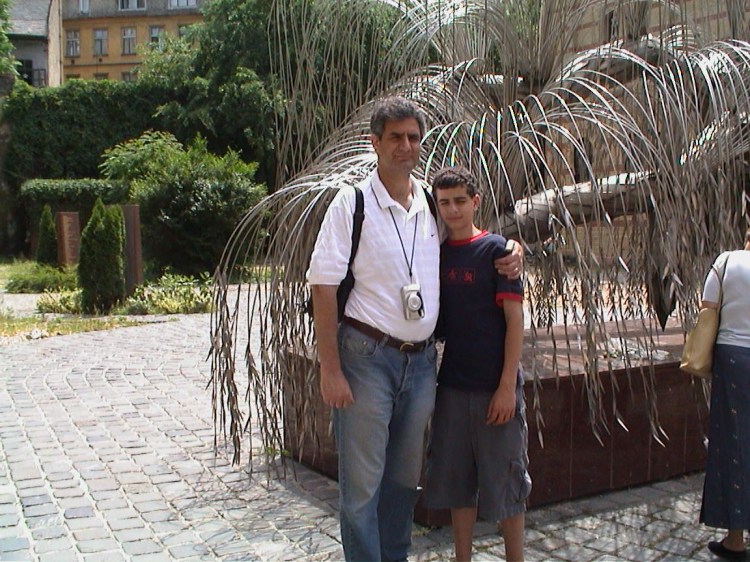
We roamed in the streets and parks in search of my father’s favorite foods-many sweets, water “mit gas” (bubbles) and of course, cholent, a heavy, heavy bean dish that my father always loved (and received from my mother for special occasions although hers did not exactly meet the strict kosher standards that my father was raised with as my mother’s recipe contained pork!). We visited bakeries, farmers markets, government buildings, rode the funicular, bathed in the hot pools and luxuriated in steam rooms, shopped at local markets, rode the trains and ate in the locals places. My father enjoyed speaking the Hungarian language again and he and my mother both enjoyed the City.
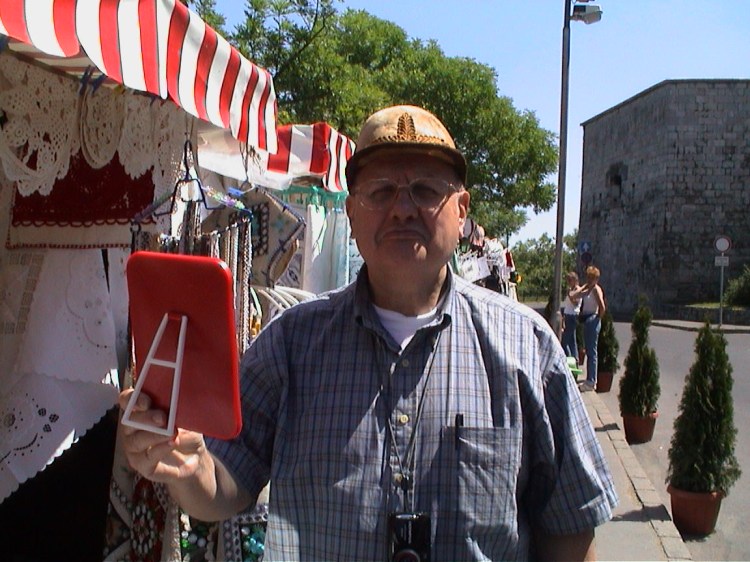
Finally, the day we had long-awaited arrived. My parents hired a driver and we took a small bus from Budapest to Mezocsat. I didn’t know what to expect-Would we be chased down the street by anti-semites? Would my father chase someone down the street who had hurt or slighted his family before he and his family were forced into a ghetto and ultimately sent to Auschwitz? I spent many nights trying to imagine what would happen. As we approached the City, my father remembered its skyline, pointing out the church steeples and guiding the driver to the remaining Temple (there had been a summer and a winter temple when my father was a child). As we parked by the dilapidated Temple, a middle-aged man pulled up in a tiny truck from the opposite direction.

As it turned out, he was the sole Jew living the City (born after World War II, divorced from his religious wife and daughter who immigrated to the United States) and he had been directed by the Mayor’s office to show us around). My father wanted to go inside the Temple so we entered from the front door.

During the war, but after the Jews were deported from Mezocsat, the Temple was used as a warehouse and stables and for other purposes I am not aware of. It was allowed to deteriorate but it was still an amazing and heart breaking experience. My father pointed out where he as the oldest child, and my grandfather prayed (bottom left) and where his mother and siblings sat (front of the balcony that ran along the right side of the Temple), where the stained glass window above the alter was, the painted curtains that covered the holy ark and the beautiful but worn Star of David design on the ceiling.
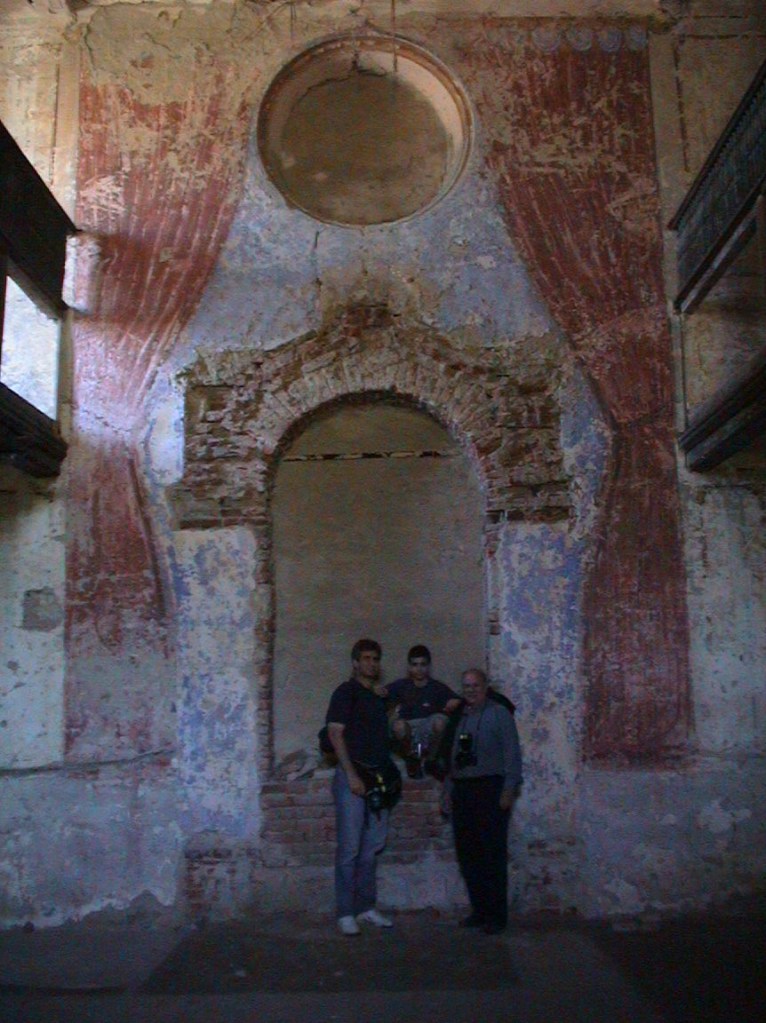

I had hoped to find the old Torah scrolls, prayer shawls, prayer books or some other evidence of the building’s original inhabitants but had no luck. I did take a brick from the holy ark and carried it around Europe with me for the rest of my trip before returning to Cincinnati with it. I wanted to take a brick for each grandchild but Barb quickly pointed out the practical difficulties of doing so.
My father, Tomi, wrote that they attended Temple on Friday nights, Saturday mornings, Saturday evenings and of course, on Holidays. His mother, Oszi, Fredy and Juditka went only to daylight services during the warm weather. His mother sat in the front row on the right hand side of the screened balcony (see above), very near the Rabbi’s wife (at the wall that held the Torah scrolls-the “Ark” while his father had the second seat from the Temple’s left wall in the second row from the front of the Temple. The kids congregated in the back and right and left side of the Temple at a long table. Juditka sat with his Mother while Gyuri and Tomi took care of their younger brothers at the children’s table on the right hand side of the Temple. When his Mother attended services, the family walked together with the children in front, directly to and from the Temple. Otherwise, we walked home indirectly with his father talking in Yiddish with several of the “neighbors”. There were only two street lights on the way to the Temple. Once during Friday night services, someone through a rock through the round window over the ark or “frigysekreny” although they never caught the thug.
During Yom Kipper services, the men wore white coats or a “kitl” under their prayer shawls (“tallit”). The dead were buried wearing their kittls. The service consisted on the Cantor singing the prayer book text and the congregation repeating it in a loud voice. The Rabbi only gave a sermon during the High Holidays but whatever he said made the women cry very loudly. He seemed to be calling everyone sinners. The Yom Kipper service lasted all day but the children were allowed to spend some time in the yard. Those who had not lost anyone in the previous year also had to go out to the yard to pray for the dead while those who did lose someone “sat shiva”. As part of the Yom Kipper service, all the “Cohens” in the congregation went up to the front of the Torah, covered their heads with their tallit and blessed the congregation. The congregation was not permitted to see them during this part of the service.
The Temple routinely provided morning prayers (Shacharit), prior to sun set (Minchah) and after sun set (Ma’ariv). In the morning, tefillin were used during the service-a practice that his father continued even after emigrating to the U.S. I now have those tefillin used by my grandfather.
The family had special Sabbath/Holiday clothing. His Mother wore a hat with a veil when attending Temple. She had brown hair and brown eyes while his father had brown hair and blue eyes. Tomi’s eyes were blue and he had blond hair when young but after my teens become light brown. Juditka had blue eyes and blond hair. The other brothers had light brown hair and brown eyes except Oszi who had blue eyes. Upon marriage, his Mother cut off her hair and wore a wig (“paroka”) that had to be sent out periodically to a Jewish hairdresser for treatment. She had at least two wigs.
Immediately adjacent to the Temple was the Jewish school where my Grandfather, Eugene Weissbluth, taught. Below find pictures from when we visited and from the time before the war, showing my Grandfather and his students (including two of his young sons in sailor uniforms).
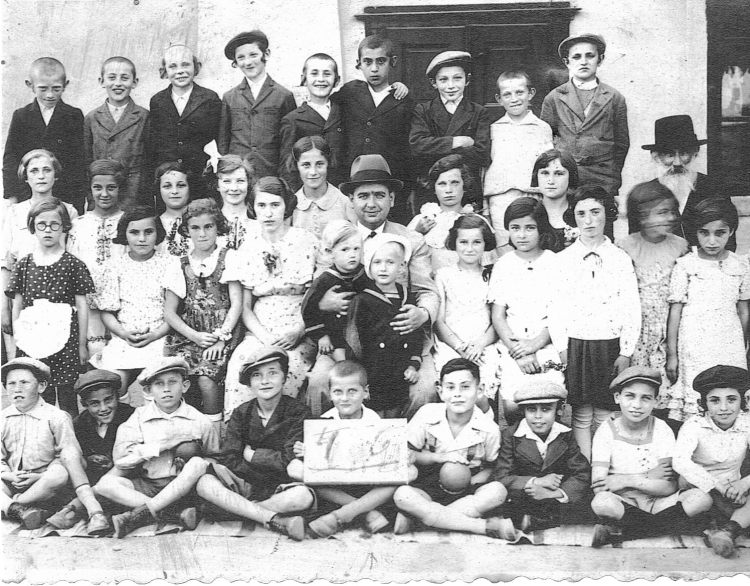
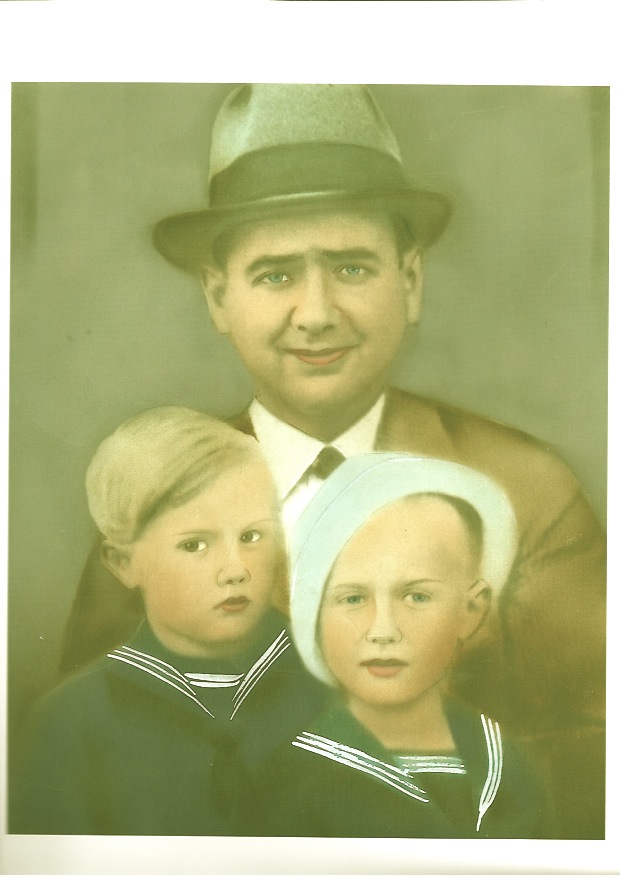
After visiting the Temple and school, we went to the Jewish Cemetery, which is now across the street from the dump. The caretakers met us at the gates, showed us around, including the little building where the Rabbi’s were buried and where wishes and prayers, like at the wailing wall, were placed.

Supposedly the Rabbi committed suicide the eve before the deportations started but I wonder about the accuracy of that statement. Would he have left his wife and children, let alone the community, to suffer that terrible fate without him? Or was he murdered?
My father was able to remember a particular grave in the cemetery-that of a young boy who died. The grave was a tall cylinder type pf sculpture that was abruptly cut off and we did indeed easily locate it.
We also spent time in silence viewing the memorial wall naming the town’s Jews killed in the Holocaust. It was very difficult to see the names of my father’s mother, brothers and sister on that wall.


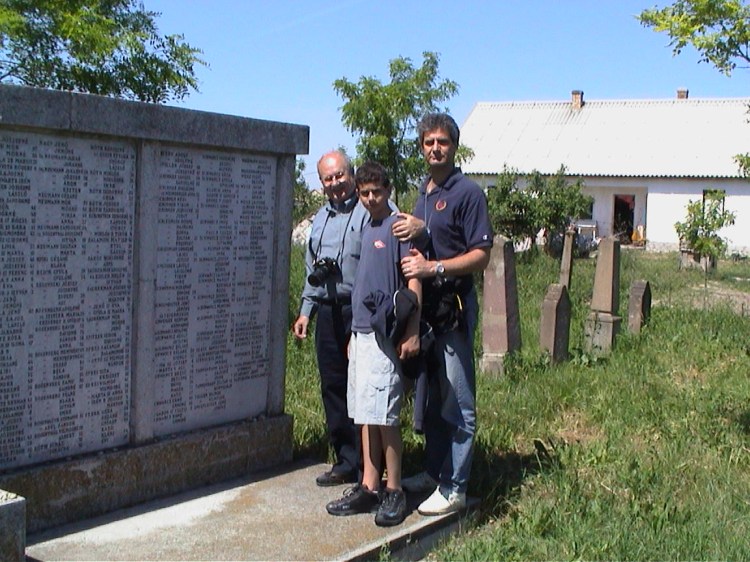
From there, we went to the City Hall, where we were greeted very nicely with snacks and drinks in what appeared to be the Town Council Chambers. A woman met us and spoke in Hungarian with my father while we all ate the snacks and waited in the warm afternoon air. After awhile, my father exclaimed in English “Oh My God!”, startling us from our thoughts. I was not sure whether was having a heart attack or what had happened. Fortunately it was goodness as my father learned that our hostess was the daughter of his former next door neighbor and that she was anxiously waiting us in her home. We promptly drove to her house where she greeted him with “Tomika, Tomika” and a rush of Hungarian that we stood no chance of understanding.

We spent several warm hours in her small home listening to the two of them converse in Hungarian, which was rather boring for us. Mrs. Taurik had baked a pastry for us so we ate and she and my father talked.

My father learned that his mother had indeed been pregnant when they were deported. He had remembered that his father had told a policeman to be careful with his wife as she was being pushed into a wagon because she was pregnant but my father had always believed that it was said only to gain some kindness towards her. e was also given two letters that my grandfather had written after the war asking about their home and personal possessions. Unfortunately, neither had been responded to by Mrs. Taurik. My father and his family were very close to Mrs Taurik and her family. They played in their yard daily, bought milk from them daily and were good friends. They were close enough to joke around, even saying that their son looked more like my grandfather than the husband. Mrs. Taurik was very excited to see my father and bemoaned the fact that it took my father’s long to return. Another resident of Mezocsat was also there to greet us-I believe her husband was a butcher and they had purchased our family home when Uncle Herman Gruenwald sold it on behalf of my grandfather after the war. We did visit the site of our family home, but it hd been rebuilt with very little of the old home left to show. It still had the poppy plants that produced the seeds that Aunt Reji used to make tea from and my father showed us the location of the old summer kitchen and garden

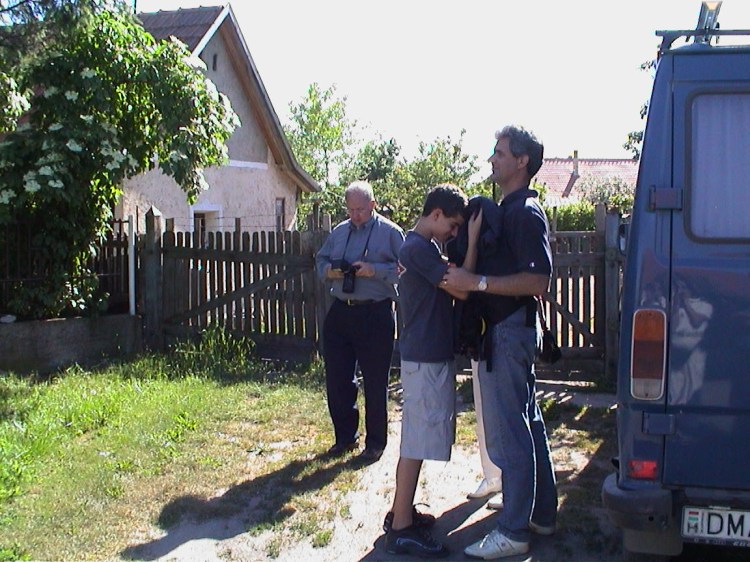
After an emotional afternoon with Mrs. Taurik, we had dinner at the tavern adjacent my grandfather’s old school. It had been a place where my grandfather had taken my father on occasion for food and an occasional sip of his beer so it was again, very emotional to eat and drink where my father and grandfather had so many years ago. From there it was a long dark ride back to Budapest as we contemplated what we had seen.
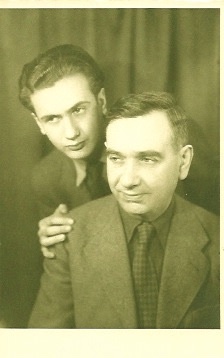

From there our journey took Barb, Alex and I back to Prague for another few days before we joined my parents in London for our final days of this journey.
Alex walked in his Grandfather’s footsteps and we watched Alex, trying to imagine my father at that age under those circumstances. Several years later, Alex and his Grandfather walked familiar steps again as Alex, along with his cousin Allison and a number of his friends, did the March of the Living led by his Grandfather.

This trip to Poland and Israel was very emotional for all concerned as Alex and his friends supported his Grandfather emotionally as they visited Auschwitz together. Alex saw where his Grandfather disembarked, received blessings from his own paternal grandfather and went through the selection process together. Alex gathered ashes from a crematorium for his Grandfather and was with him as he spoke as the representative of the United States and when members of the Hungarian delegation excitedly spoke with him.

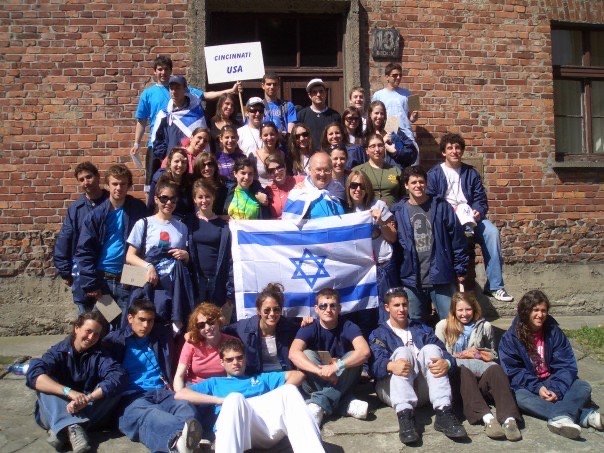
“May his memory be a blessing” is a common refrain when mourning someone’s death, but what does this really mean? I believe that the life of someone like Thomas Reed influences family and friends for generations to come-they help shape the personalities, values, life styles, desires and motivations of their children, grandchildren, friends and acquaintances. Tom’s grandson Josh Olkes often shares videotapes of Tom telling stories of his mischievous youth with his own daughter, Emilia. You can bet that this is just one example of Josh passing on the history of our family to yet another generation.
Education was of the utmost importance to Tom. Although as a child he was never that interested in school, he realized the value of it as a young adult and worked hard to get his degree in electrical engineering and later in law, seeing both as important steps on the road to independence as well as intellectual stimulation. He and Lora both stressed the value of education with their children and were quite proud of all of their accomplishments in that realm. Mike received a degree in finance and went on to receive his J.D., allowing him to practice law. Judy received a degree in marketing from Ohio University and then a masters and doctorate in special eduction from the University of Wisconsin. Susie received an associates degree in accounting. As proud as he was of the educational opportunities provided his children, he was equally as proud if not more so of the educations his grandchildren received. Ben received a two undergraduate degrees from Brandeis University, majoring in ________ and Health Care Policy while earning a minor in Spanish. He then obtained a masters in public health from Dartmouth and a medical degree from he University of Dayton before doing a pediatrics residency at the Cleveland Clinic and a fellowship in Neonatology at Children’s Hospital in Cincinnati. Andy earned a degree in Economics from the University of Colorado at Boulder and Alex received a degree in Fine Arts from the New York State College of Ceramics at Alfred University and attended Harvard for his masters in Architecture before dropping out, deciding that the time spent was not worth giving up the work he had developed during his nine years living in Los Angeles. Ben and Alex both attended their college graduations but Andy opted out due to the size of the graduating class. Both Ben’s and Alex’s graduations where very special-Ben had general graduation and then smaller ceremonies based on the majors he had chosen. Alex had been nominated as one of the two “Outstanding Seniors” in his class and though not ultimately selected, all were very proud of this recognition of an incredible young man. His graduation was also supplemented by his Senior Art Show, which was a wonderful event.
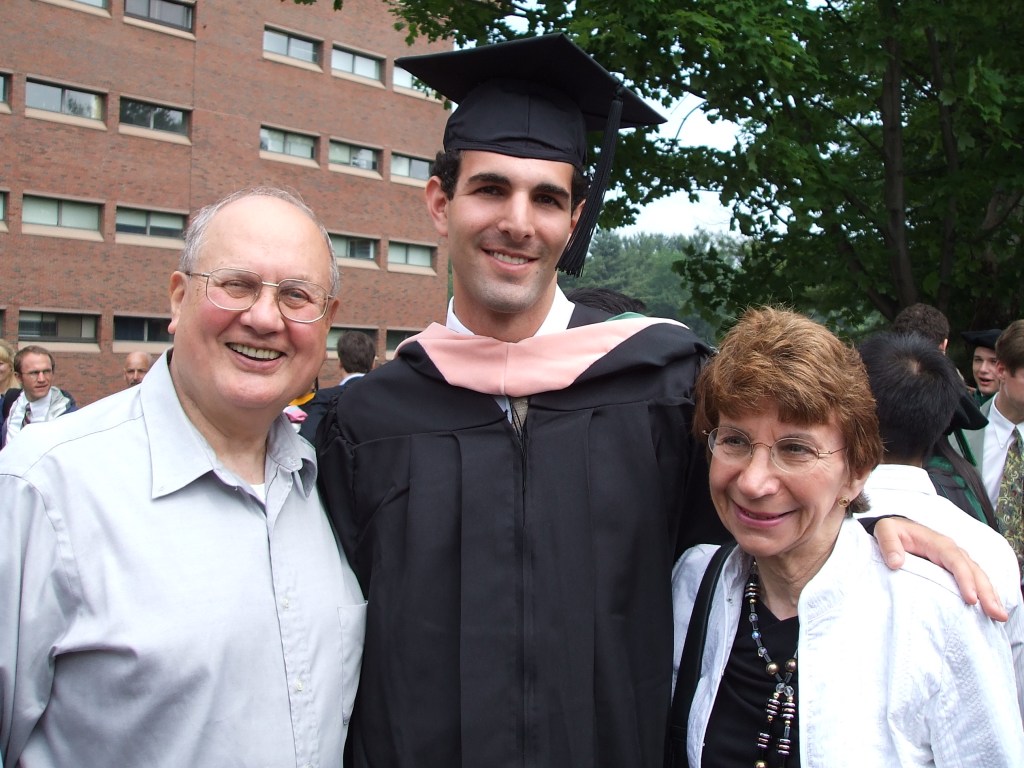
In preparation for his first trip back to Hungary since he was deported at age 12, Tom wrote to the Mayor of Mezocsat.

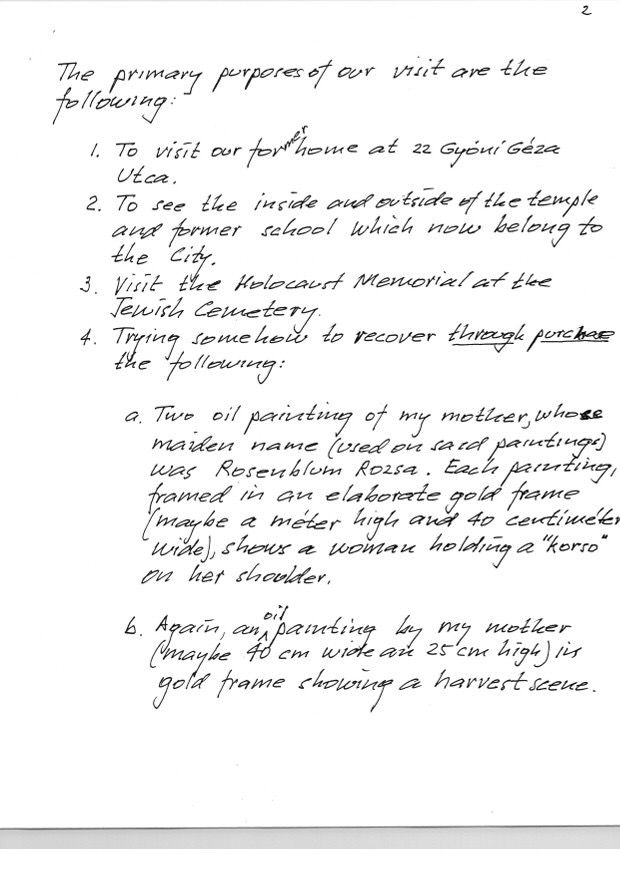


In May of 2022, Tom’s son Mike, and along with his own first born, Ben, made another trip Hungary to learn more about the family’s life in Hungary. Tom’s paternal grandparents lived in Hejocsaba, Hungary, which was a small city outside of Miskolc, Hungary. Now it is a suburb of Miskolc. Tom’s grandparents are pictured below in the only known picture of them.
Tom’s grandfather was the Rabbi and kosher butcher and perhaps took care of the local Temple. He came from a line of Rabbis. This Temple was quite large and was too big for the size of the local Jewish population. Unfortunately, they too were deported from their community, joining Tom, Eugene, Rose and Tom’s siblings in the brickyard in Diosygur (about five miles west of Miskolc) before being put in the cattle car that took them to Auschwitz. Upon arrival and being rousted from their train car, Tom’s father gathered his son and grandson (Eugene and Tom) between the railcars, told Eugene he had been a good son and gave him a priestly benediction before they went through the selection process.
When Ben and Mike visited in May of 2022, the Temple in Hejocsaba no longer existed but the memorial wall listing those Jews from Hejocsaba that were murdered in the Holocaust had been moved from that Temple to the Temple in Miskolc. The graves from the Hejőbába Jewish cemetery were transferred to cemetery in Miskolc in March 2009. Since our family was murdered in Auschwitz, I do not believe there are any graves in any cemetery for them. It is believed that as part of the transfer of artifacts from Hejobaba to Miskolc, the memorial wall listing some of the Holocaust victims is pictured below.


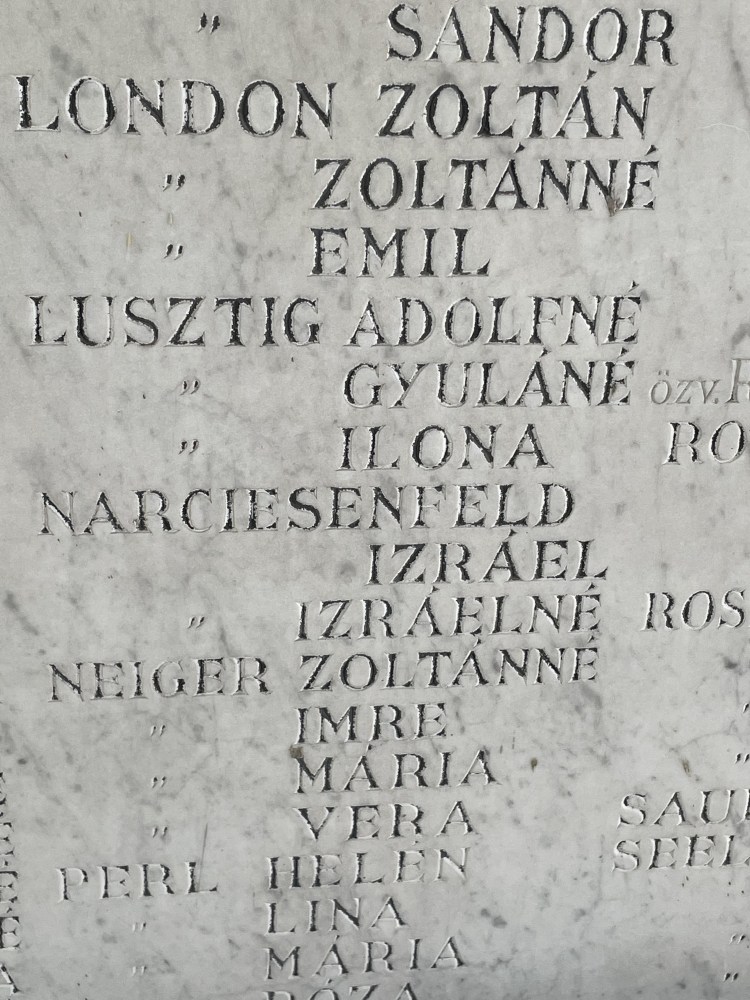
There continues to be a Jewish population in Miskolc and when Ben and Mike visited on a Saturday, a service was in process. The old Temple, which was quite large, was no longer in good enough condition for continued use so a smaller, more modern facility was integrated into the Temple’s campus, which took up quite a bit of real estate.
Pictures of the old Temple follow, but most importantly, the Memorial Wall, containing the name of Tom’s paternal grandparents was still there, featured very prominently in the lobby area. Ben and Mike may have been the first, but hopefully not the last members of our family to ever witness this wall in person.

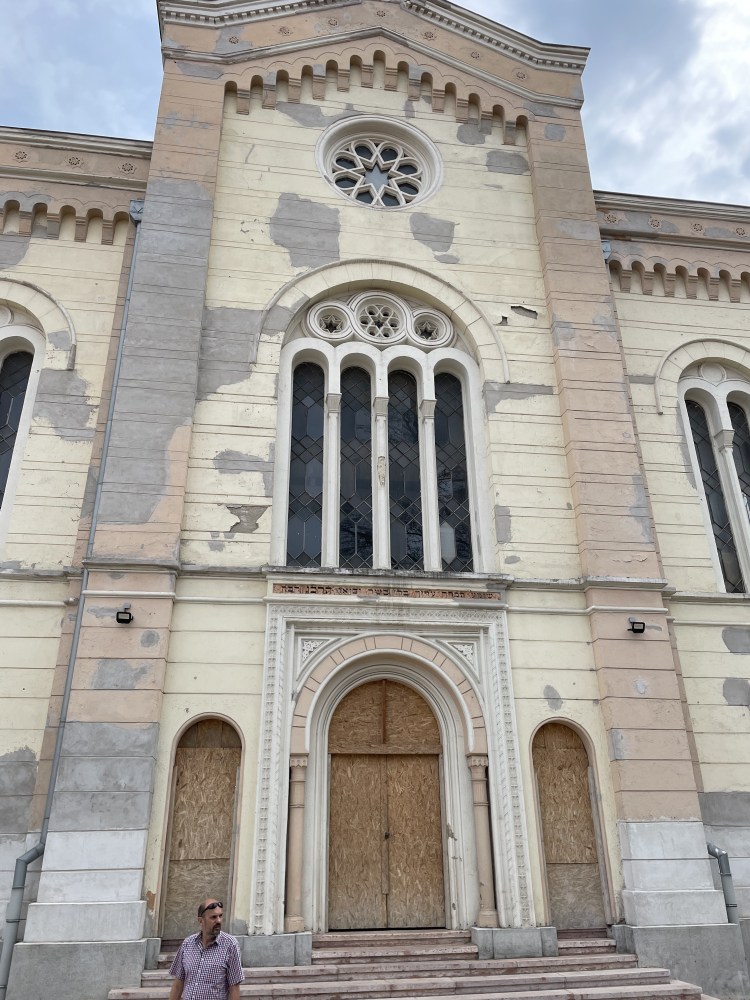

From there, it was short drive to Mezocsat, where Ben and Mike were met by the Mayor at the site of the Temple. The Mayor kindly gave them a tour of the former Temple, now civic center/arts hall.
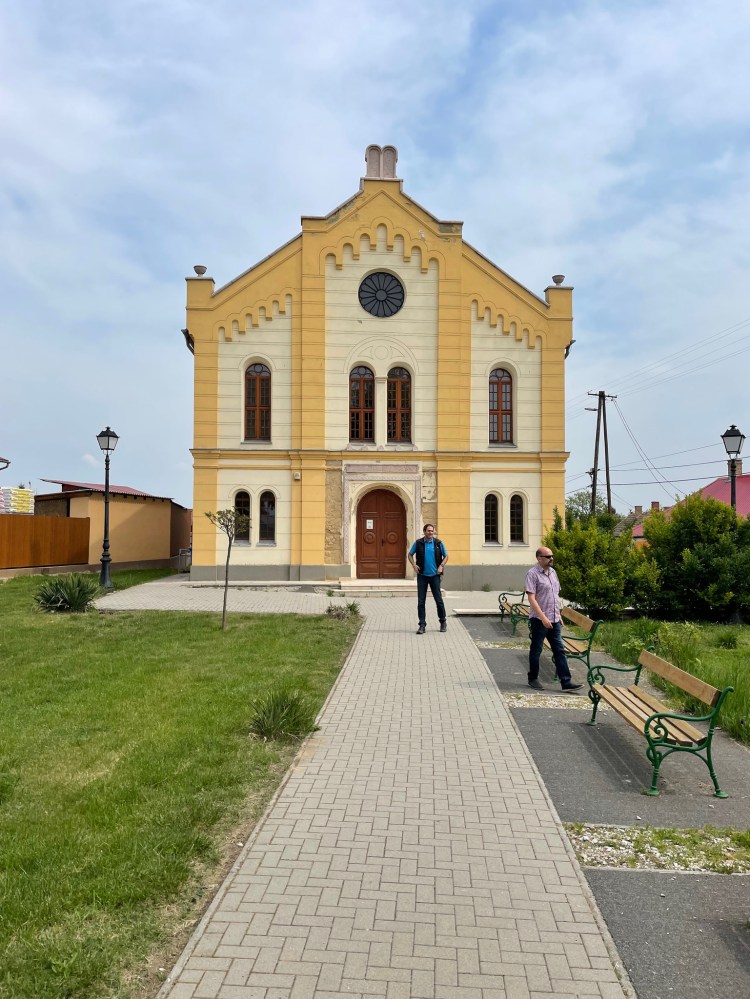

Thanks to a government grant, the Temple was restored in 2013 although in 2022, it appeared to need work again as shown in some of the following pictures. The ceiling had been repainted and included the Star of David in its motif as did the wrought iron bannisters leading to the second floor.


Mike showed Ben where Tom and Eugene had sat to pray on the bottom left of the ground floor and where Rose and Tom’s brothers and sister sat on the right side of the second floor. The drawn curtain adjacent to the Holy Ark had been repainted as well although there was a heavy black fabric curtain covering it for day to day use. The brick base to the Holy Ark had been replaced (Mike wondered if they would be able to replace the brick he took home with him on his previous journey) with a new base so Mike was unable to take home any new souvenirs.
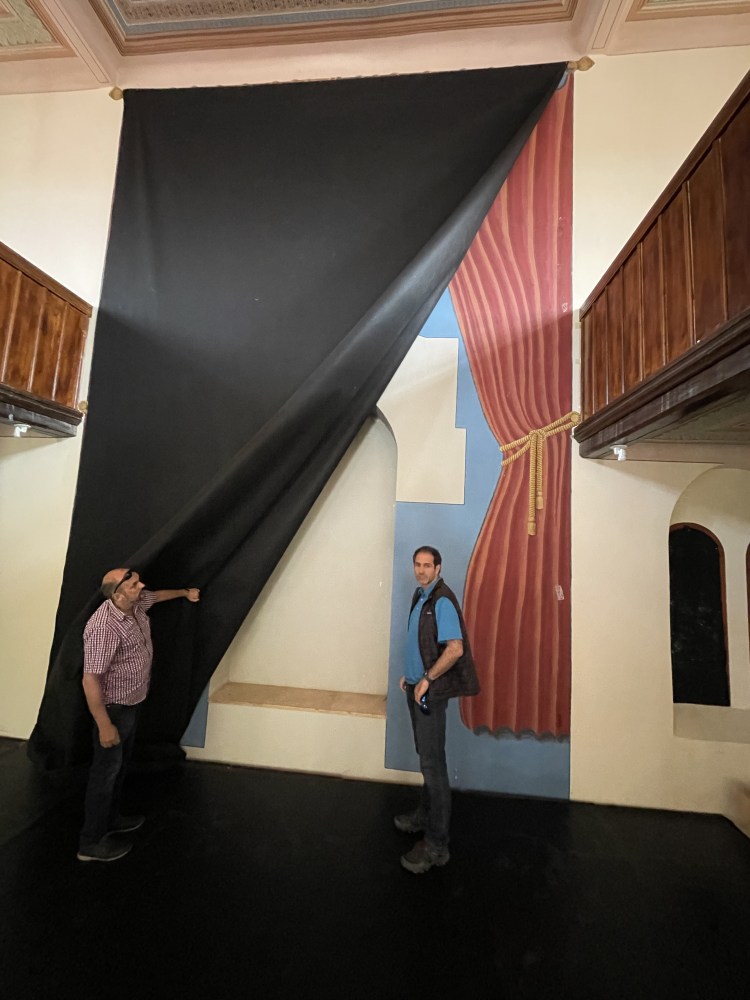
Ben Reed on Right and Guide on Left
It was sad to see that the the School where Eugene labored for so many years as a teacher and headmaster had been torn down as was the tavern next-door where Eugene had occasionally allowed Tom to sip from his beer and where Alex, Barb, Mike, Lora and Tom shared a meal during the earlier visit, approximately 21 years earlier.
From there, the Mayor took Ben and Mike to the Jewish cemetery to pay their respects and to view the Memorial Wall containing the names of those residents of Mezocsat murdered as a result of being deported by their former friends and neighbors.


Tom’s mother, brothers and sister were listed and Ben and Mike placed stones on the wall in this overgrown reminder of the lost Jewish community of Mezocsat. They also viewed a gravestone Tom had remembered as a child-a column broken off part of the way up, memorializing the death of a child, whose life’ was cut short or interrupted far too soon.
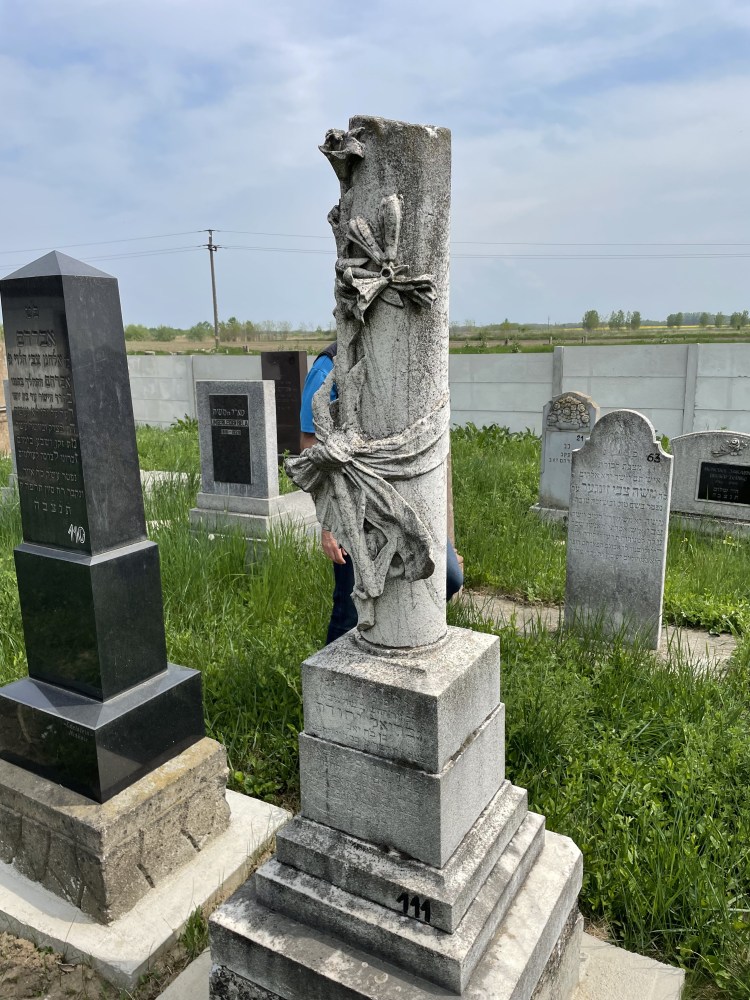
The special building in which one or more rabbi’s were buried was in the process of being renovated and a lovely, new tall white wall, paid for by a Jewish family that once had ties to the community, now surrounds the cemetery.


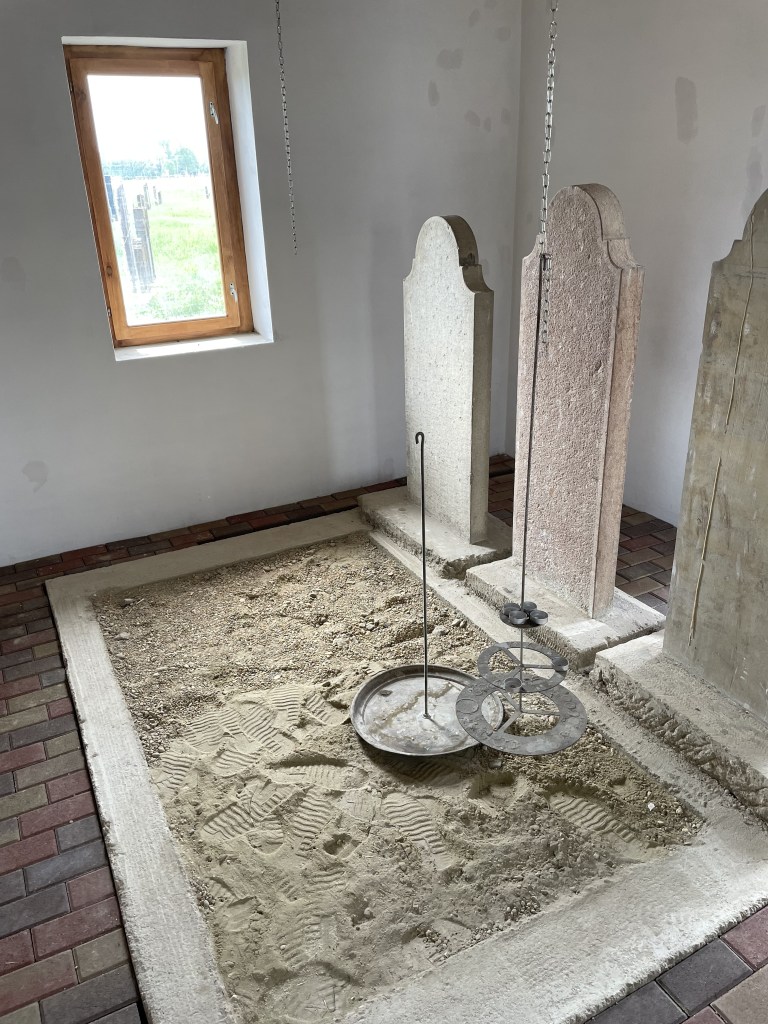

Next, Ben and Mike visited the site of the former family home at 22 Gyoni Geza Utca. Although a new house at been built on the property, their hearts were heavy with feeling. looking at this site and thinking of the happy family that had resided there along with the Tourik family who lived next door. The neighbors across the street were curious about the visitors so the Mayor introduced them. They were very welcoming, telling Ben and Mike that they had lived next door since 1961 and that the husband’s grandfather had lived across the street. They prepared hot sour cherry pastries and served them along with cold beverages to their guests. Next Ben and Mike visited the abandoned railroad station two which the family had been forced to walk. It was a spooky place and Ben and Mike could only imagine the fear, anger and humiliation that the Jewish citizens of Mezocsat felt as they were marched past their former friends and neighbors to the station carrying whatever meager possessions that were permitted. While Ben and Mike understood that the current citizens of Mezocsat were not responsible for the crimes of the past, there was still much underlying anger on the parts of Ben and Mike. After that, Ben and Mike asked that they be shown the Jewish ghetto and following that, the outdoor market where the Jews were gathered before being marched to the train.
It is important to understand that it was their neighbors and friends who turned on the Jews of Mezocsat, which is why Tom hated the Hungarians so intensely. Tom’s family had been very close to their next door neighbors the Touriks. They used to play in each other’s yards, buy their milk each day from the Touriks and were in fact so close that the Touriks used to joke that their son’s nose looked more like Eugene’s than that of Mr. Tourik. When Eugene and his family were forced to move into the designated ghetto in Mezocsat on June 18, 1944, Eugene gave the Touriks some tools in exchange for which the Touriks were to continue to provide milk to the children. This never occurred and in fact, even after the war when Eugene wrote Mrs. Tourik mother-in-law twice, telling her that they had survived and asking about their home, no response was made. Mrs. Tourik was no longer living in May of 2022 and the Mayor did not know her daughter, who greeted us on our prior trip while working for the Mayor. There had been only one Jew (non-practicing and born after the war) when when visited previously and he had died five years earlier. The streets were now all paved and there were only a few thatched roofs. although the storks still nested peacefully on the poles lining the streets. The Mayor gave as a book about Mezocsat, her email address and some miniature examples of the pottery jugs made locally. We had plenty to think about on our return to Budapest. As an aside, Ben and Mike visited the Dohaney Street Temple in Budapest-the second in size only to a Temple in New York. Aunt Erika Gold (nee Taubner) was confirmed in that Temple and lived in the ghetto immediately adjacent to it during the war. The ladder that Tom had gleefully climbed to the consternation of the Temple staff was now locked off to prevent further transgressions.
One thing that remained the same from the prior trip to Budapest was the steel shoes along the Danube, symbolizing the Jews of Budapest who were periodically lined up on the banks of the river, like on Christmas Day, and were shot and after their shoes were removed, tossed into the river. While Budapest was interesting and the trips to Miskolc and Mezocsat brought their own rewards, Ben and Mike could not help feeling lighter upon their departure for the next leg of their journey-a trip to the city of Feldafing, Germany, located in Bavaria.
As it became clear that the German’s were losing the war, the command came down from on high to eliminate the concentration camp survivors as they were witnesses to the atrocities committed by the Germans. As a result, concentration camp survivors were to be moved to areas well behind the lines where the Germans planned on killing them. Some marched without food and water, with the weak, sick and those who had given up were shot and clubbed to death by the merciless German guards. Others, like Eugene and Tom, were once again placed on trains, again, without food or water, to be moved to the Carpathian Mountains to be killed upon arrival. The inmates on the Dachau sub camps of Muhldorf, Mettenheim and Mittergars were among those placed on trains and were eventually liberated by the Americans at a railroad station in Tutzing, Germany, close to to the town of Feldafing after having been an unwilling passenger on the so-called Muhldorf death train where roughly three-thousand mostly Hungarian Jews who had been imprisoned at Muhldorf were marched out of the town on April 25, 1945 and then forced onto a long, slow-moving train, designed to bring them to their deaths, thereby eradicating any possibility of survivors or witnesses to the atrocities. A few days into the ride the train had either broken down or rumors of the war’s end had frightened the SS Guards into stopping the train, and for a few hours many of the prisoners temporarily escaped, fleeing toward the rural town of Poing. The guards told the prisoners they were free and then shot them as. they ran. The SS forced the survivors of the massacre to throw many of the dead and critically wounded back into the cattle cars.
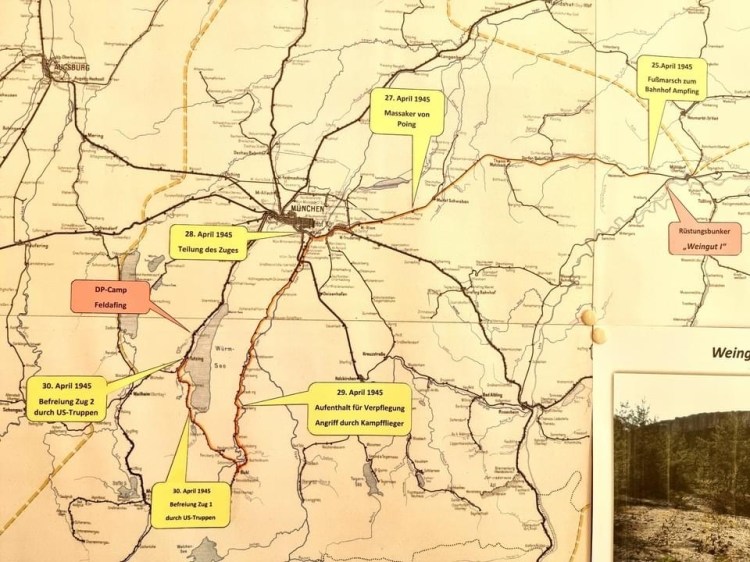

There was a “Reichsschule”, an elite Nazi youth school in Feldafing with barracks and the Americans needed a place to house the survivors of the train’s journey. The students and their teachers were kicked out and the Jews were moved in so they could be treated, fed and housed. Eventually, the displaced persons camp that was formed held as many as 6,000 people, operating from 1945 to 1953. Over 700 babies were born the local hospital, which was eventually transformed into the Hotel Kaiserin Elisabeth. The lobby of the hotel was the former maternity ward.
It was in this camp that Eugene and Tom made their home (Block 4) immediately following liberation-where Tom recuperated after being shot in the leg during the final days of the war and where Eugene would meet his second wife, Gertrude Guttman.


The town of Feldafing is in a bucolic setting-lots of greenery, beautiful hills, a large lake (Lake Starenberg), a golf course, and a good view of the the Alps all add to the serenity of the area. Wealthy residents of Munich, including Jewish families, had summer homes in Feldafing before the war and it is still considered a resort area in 2022.


This camp is now located within the boundaries of a German military base but thanks to a Facebook group (Families of Feldafing) and some local help, a tour was arranged. It was a strange feeling to be accompanied by friendly people in German military uniforms when our parents would have been so terrified by those same figures. There are still eight of the original barracks on sight along with a small museum. Ben and Mike took a train from Munich to Feldafing-something Tom and Eugene did many times during the four years they live-in Germany after the war, and stayed at the Hotel Kaiserin Elisabeth along with approximately twenty others. The group toured the former DP camp accompanied by the Colonel who ran the base and the Captain whose interesting the history of the camp resulted in the creation of the museum. Ben and Mike spent a lot of time with other members of the Facebook group, many of whom had actually been born at the Hotel Kaiserin Elisabeth after the war. It was a very emotional and rewarding experience as these people had similar stories, sometimes eerily similar. They came primarily from the United States and Israel although two couples came from Germany itself. The group spent hours sharing stories and pictures. Rose Nieman said that her parents lived in Villa Kindergarten and that their next door neighbors were a father and son who had also survived the war. Mike thought that his father and grandfather had lived in Kinder Casino but the map showed no such place. According to a document prepared by Tom, they lived at least for a period of time in Block 4. Given the few father-son combinations that survived the war and the similarities between the names of the two residences, it appears likely that her parents and my father and grandfather were indeed good friends and neighbors in post war Germany.


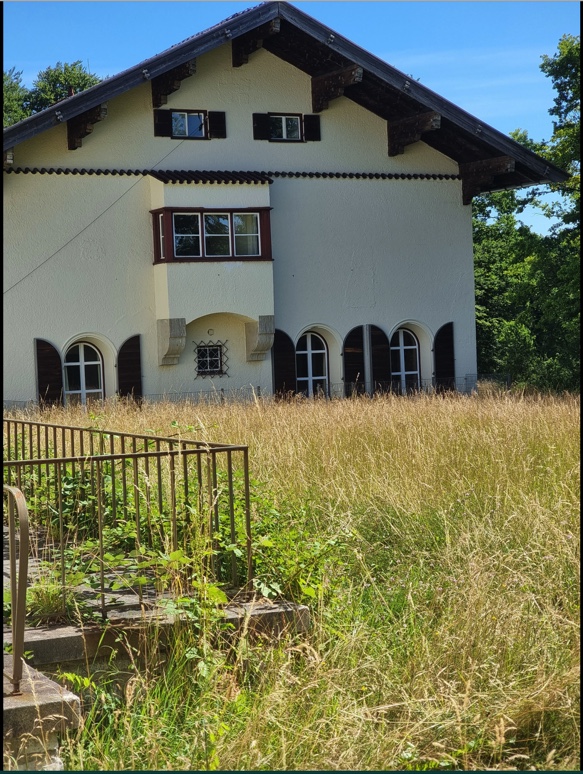
After the tour of the DP camp, the participants toured the Jewish cemetery that was created to accommodate the Jews that died while living in Feldafing. Although some died in the days and months following liberation as a result of injuries and illnesses suffered during the war, others died in childbirth, from natural causes and in some instances, from terrible luck, such as car accidents.
Below you will find a picture taken at a funeral and next to it, a picture of the same grave in 2022. Following the visit to the cemetery with the Mayor of Feldafing, the group was taken to a reception sponsored by the town of Feldafing where the Mayor formally welcomed the group, talked of the terrible actions in the past and how happy they were to have our group return to an area where the victim of the Nazi regime could begin to make the transition from hell on earth to some degree of normalcy. That evening the group was treated to a wonderful dinner at Gasthof Schauer by the town as well. The bonds within this group of the families of Feldafing were strong and the group is committed to stay in touch and share their experiences. A husband wife team of historians helped organize the events and there was also an archivist and college student doing her thesis on the DP camp present. Several articles about the trip appeared in Munich as well as local newspapers.
In addition to Tom and his father, several of Tom’s cousins lived either with them in the same rooms at Feldafing and or in the DP camp. This included Tom’s cousin, Putchi Berger, pictured below, as well as his cousins Edit, Aliz and Tibby.

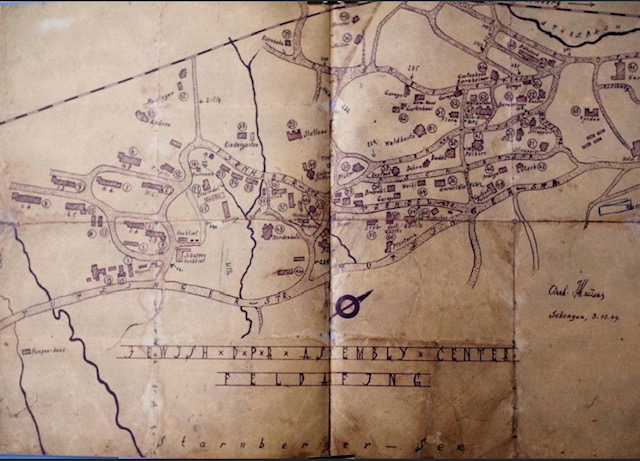


My earliest memory of anything Holocaust related was a discussion I had with my father while the two of us were laying in my bed, as a child. I asked him about the absence of his mother. He told me that he and his father had gone out and when they came back his mother was gone. We never discussed the issue again as my father really avoided discussions regarding his family and their war time experiences until he decided to visit Mezocsat and several of the camps where he had been interned, for the first time since 1944. I asked if he would mind if we accompanied he and my mother and he agreed. Following that trip, he started to speak at schools and universities. He got involved with the Atlanta Holocaust Museum and related organizations. He even spoke at this grandsons’ school on the subject of the Holocaust and wrote about his experiences. I am amazed at the details that he, as a 12 year old, was aware of and recounted.
The deportation process started when the Jews of Mezocsat were forced to move into a local “ghetto”. The ghetto was not specially built for them but was really a small cordoned off area of Mezocsat. They were forced to report with a meager amount of belongings whereupon they were forced to live in cramped quarters, with many people to a single room, in existing housing stock within Mezocsat. As noted elsewhere, Jeno Weissbluth gave his neighbors, the Touriks, some tools and equipment in exchange for their promise to continue to supply the Weissbluth children with milk during their stay in the ghetto. Not a single delivery of milk was made. In fact, no food was provided and the family was not permitted to shop for any food. After approximately three weeks in this ghetto, the Jews of Mezocsat were marched out of the ghetto to an outdoor market area/building yards, along with whatever items they could carry. They were searched for valuables by the police and midwifes with the police looking on while the women were searched. After a few days in the yards, they were assembled in a long line and marched as a group through town to the local railroad station carrying their meager belongings in pillow cases.
Once there, they were crammed into cattle cars and eventually transported to an open brickyard at Diosygor. Below is the last view that Jeno, Tom and their family had of their town.


When we visited Mezocsat on our first trip, we happened upon a man standing around or working at the station. This man told us his father had been there and had given some of the Jews locked in the cattle cars water as it was summer and the heat was brutal. If true, not many others joined in this effort.
From the railroad station in their hometown of Mezocsat, the train made its way to Diosgyor, a town located within their region which served as a collection point for the Jews deported from that section of Hungary. From the train they were placed in an open brickyard where they were joined by Tom’s paternal grandparents, Josef and Gisselle Narcisenfeld, who arrived from nearby Heyachob. There, they along with the other Jews from that region, lived in that outdoor brickyard from about three weeks, with minimal food and no shelter, privacy or formal bathrooms. There were several water faucets, but people were forced to exercise their bodily functions in a nearby ditch. Everyone slept on the hard ground.
“In June of 1944, the middle of the five transports left Miskolc, Hungary. Following the invasion of Nazi Germany, the local Jews as well as those from surrounding villages” (such as Heyachob where Tom’s paternal grandparents lived) “were interned in the quarry in Diosgyor and the municipal brickyard. Because many of the hard working men had previously been dragged off to work on the Eastern front, it was mainly women and children, the old and the sick. At both sites, there were terrible hygienic conditions, lack of water and food, oppression and humiliation by supervisors. About 14,000 Jews were taken to Auschwitz-Brezinka, who were mostly murdered in gas chambers immediately upon arrival”. (Resource-Yad Vashem)
After weeks in this limbo, the Weissbluth/Narcisenfeld family, along with many others, once again were entrained and transported under horrendous conditions, to Auschwitz. They were jammed into cattle cars with a single bucket of water and an empty bucket for use as a toilet. The journey to Auschwitz was about five days in duration, with numerous stops and starts. On a few occasions, they received water and would empty their open bucket. The family, unlike many others, survived the hellish journey to Auschwitz, but were then separated during the selection process. Josef Narcisenfeld blessed his son during a stolen moment between rail cars before the family proceeded through the selection process. As the approached the head of the line, Jeno realized that there was an age cutoff-people below the age of 17 were sent one way along with those who were elderly, sickly or too young while healthy people of a certain age were sent in another direction. Jeno told Tom to tell the person making the decisions that when asked for his birthdate, he should lie and give a specified false one to ensure he went with the healthy group. When Tom provided the answer provided by his father, another person from his town in line behind him shouted out that Tom was not the age he claimed. Miraclously, the person making the decision told him to go with his father while his younger brothers, sister, mother and paternal grandparents were not selected for life. A day after being in the camp, Tom asked a man when he would get to see his mother and siblings. The man told Tom to stand up on a box and pointed up a stream of smoke arising from a nearby chimney- “That”, he said, “is your family”. That is how this 12 year old boy learned that his mother, grandparents and siblings were all dead.
Jeno and Tom were transferred Auschwitz II, otherwise known as Birkenau. Tom recalled as follows:
In the Gypsy Camp (named after a family of gypsies housed on the high hand side barracks as we faced the camp from the gate-some barracks had special uses-the Gypsies were gassed a few months after we were there) we were marched into a barrack which was designed as a stable for 38 horses and a room at each side on the front for the grooms. The floors were all cement and the slightly sloping floor towards the middle on each side lengthwise was to accommodate 19 horses. Int he middle on each side, lengthwise there was a narrow walk and between these walks ran an elevated brick heat flue which ended up in a brick furnace. At one end of the two parallel rows of barracks were the two rooms now occupied by the Gypsy in charge of the barrack, his assistant and their families. This end of the barrack opened onto the camp street. The other end of the structure opened towards the triple barbed wire fence withthe middle fence being electrified. At this end of the barrack there were two barrels, one at each side of the double doors for night toilets. The fences and the area between the barracks were covered by machine guns mounted on towers. In the barrack, probably number 2, we were lined up on the lefthand side, my father and I towards the barb wire end, with a dead man lying on the floor. This was the first time I had seen a dead man. There, an SS man told us that if we had hidden anything in our shoes to hand it over because they were going to X ray our shoes and if anything was found, they will hang the owner. Some people did as they were told.
After this were re marched to barrack #10 and we met our two Gypsy bosses and their Slovakian Jewish translator, whose name was Weiss. As it turned out, Weiss slept on the chimney flue and a pile of blankets. All three of them carried large thick canes. They immediately lined us up between barracks #9 and #10 and Weiss told us the rules. These included absolute obedience, staying between the two barracks during the day, the ability to use the toilet three times a day, standing at attention, no talking while in formation, and taking our hats off when any German was nearby as well as standing at attention. They marched us around in a single file in front of them and took away the shoes and belts they liked. They replaced the confiscated items with a piece of string (better than a belt for suicide) and canvas topped one piece wooden soled shoes. We were still completely confused and did not know about anything except what we had experienced thus far. From between the barracks, near the camp street, several buildings with huge smoking chimneys were visible.
For lunch, we were lined up in depth of ten and each “front” man was handed a utensil, to be used to scoop out the contents of the pot in front of him, some of which were night pots. Each pot was filled with that we found out later was called “doergeueze” (a thin, watery vegetable soup containing none of the desirable vegetables. Each of us while standing in our row (10 men deep) drank from the same utensil. Subsequently, we were permitted to go across the street to the latrine/washroom. The latrines were long rows of holes in an elevated cement platform and there was no toilet paper available. Across from the toilets were faucets but no soap or towels of any kind.
The first afternoon we were left alone until evening when we received a weak artificial “coffee” (sometimes “tea” in later days) to be drank in the same manner as the soup. As it was getting towards dark, we lined up double file to enter the barracks. While marching in we were each handed about two slices of so called “bread” which was mainly sawdust with a tiny piece of butter on it. A short time later we were ordered to lay down for the night in the area where the horses would have been. We laid down directly on the concrete and were so tight due to our numbers that we could only lay on our sides. Thus, one slept on his same side all night. When I laid down between my father and another man, he introduced himself as Dr. Fekete (Black in English). Thus ended my first day in Auschwitz (Birkenau) even though we did not know those names yet or the anything as to what happened to our loved ones.
After several weeks in Auschwitz, Tom and Jeno were transferred to from KL Auschwitz to KL Dachau of July 11, 1944 where Jeno was assigned number 79767 and Tom was assigned number 79768 and then to a sub camp known as Munchen-Allach via train on November 7, 1944, for several weeks. The Allach concentration camp was where BMW was manufacturing airplane engines. The Muhldorf camp complex was built in mid 1944 and was manned by the SS. It’s purpose was to provide labor for an underground installation for the production of the Messerschmitt 262 (ME-262) . The Allied air offensive caused the Nazi’s to decide to construct underground installations to produce weaponry. The SS used concentration camp prisoners to carry out he most dangerous work–building tunnels in the mountainside and caves, building underground factories and hauling construction materials. Most of the prisoners were Hungarian. Conditions were dismal-The SS guards carried out selections with he sick and disabled beingshippied to Auschwitz or murdered or worked to death in the camps. Prisoners frequently worked 10-12 hour days carving 110 pound bags of cement or other difficult tasks.
From Allach, they were transferred via truck to Muhldorf-Mettenheim where they spent the next eight months. From there they were transferred via truck to Mittergars for five months and then via truck again to Muhldorf-Mettenheim. At that point, they boarded a “death train” to a then unknown destination.
As the Germans came to realize they were going to lose the war, they decided to try to hide the evidence of what they had done. To that end, they started terrible death marches, emptying the concentration camps of prisoners and sending them further from the front to find a place to kill the survivors of those brutal marches. Some prisoners, like Jeno and Tom were placed on trains. to speed up the transported prisoners to a place where they could be killed and bodies disposed of with less risk of discovery. Greif and the duo of Jeno and Tom had made an arrangement to help each other escape-Greif would walk them away from the Nazis at gunpoint and when they approached American or other Allied Forces, the duo would continue with Greif as their prisoner. Tom and Jeno were placed in a train car along with Grief, his two sisters and a food supply. After several days on the train with most prisoners getting nothing to eat or drink, the train stopped in Poing, Germany. It is unknown as to why the train stopped but it did. At some point, the guards announced that the Americans were there and the prisoners were free to go. Many of the prisoners did not need to be told twice so they rapidly departed. Jeno sensed that something was amiss and told Tom to stay put along with Grief. The SS guards started firing on the departing prisoners, killing and wounding many in what became known as the “Poing Massacre”. Tom watched one guard continually shooting children while another focused on women. As the shooting died down, another guard approached the trio and he pointed his rifle at Tom. He accused him of trying to escape and was going to shoot him but Greif interceded on his behalf, telling the other guard that those two had been with him the entire time and had not tried to escape. The other guard argued with Greif but Greif outranked him and prevailed. The guard, not to be denied, said if Tom had not tried to escape it must be the person standing next to him and he immediately shot him in the head. As this was going on, Tom saw a man laying at their feet eating bread taken from the car in which Jeno, Tom and Grief were staying despite having been shot in the head. With the angry guard pointing his rifle at him and the two guards arguing, Tom thought he was going to die so he prepared, saying the watchwords of his faith-Sh’ma Yisrael, Adonai Eloheinu, Adonai Echad! (Hear, O Israel, Adonai is our God, Adonai is One)! In the melee, Tom was somehow shot in the upper thigh. Grief was called to a meeting of guards and when he returned, he told Jeno and Tom that the plan was to kill everyone in the morning. Since Tom could not walk, Greif tried to convince Jeno to leave Tom and proceed with their plan but thankfully, Jeno refused. Somehow the two of them had managed to stay together throughout the horrors they had experienced and Jeno was not about to abandon him at that point. The next morning, they awoke to hear loud noises and gratefully learned that the Americans had really arrived. Americans wound up liberating the train filled with many dead and dying prisoners. at a railroad crossing in Tutzing, Germany. They wanted to transfer Tom to a German hospital train to have his wound treated but Tom refused, not trusting anything related to the Germans. The Americans knew they needed to quickly find a place to treat and house the survivors and they located a school for well connected Hitler youth in the nearby town of Feldafing. Tom and Jeno entered the barracks in Feldafing in June, 1945 and they remained here until 1948 at which time they moved to Munich. In Munich-Schwabing, they lived at Gedeon Strasse 4, on the 4th floor from 1948 to 1949. In June of 1949, Jeno and Tom boarded the USS Balou and arrived in New York on June 13, 1949
The following is a very brief history of Tom’s Journey through the Holocaust written by him in conjunction with a reparations claim he filed late in life:
My Journey Through the Holocaust
By
Thomas Weissbluth Reed
Born in Hungary on October 2, 1931
Age at the start of my holocaust: 12 years old
Age at the finish of my holocaust: 13 years old
Places of incarceration:
-Mezocsat Ghetto
-Diosgyor brick factory (departure to Auschwitz)
-Auschwitz Birkenau Camp
-Train ride to Munchen-Allach (BMW)
-Munchen-Allach via truck to Muhldorf-Mettenheim
-Muhldorf-Mettenheim via truck to
-Mittergars return to Muhldorf – Mettenheim
-Boarded “death train” to the unknown
-Liberated by the U.S. Army at the train station in Tutzing, Bavaria-wounded but free at last
Family killed upon arrival at Auschwitz
My father’s parents
My mother
My three brothers
My little sister
After the Germans occupied Hungary, within a very short period of time, we had to wear yellow “stars” and a ghetto area was designated in Mezocsat. We had to close our dwelling and move into one of the Jewish occupied houses or their yards in said ghetto area. We were fortunate and received a room for the seven of us. We took with us beds and all the food we had. All the contents of our home had to be placed in one room that was officially sealed (the next day after we moved, the seal was broken and the plundering of the rooms contents began, initially by well-connected people and later in a “free for all”. We stayed in the ghetto for a period of time and then we were lined up on the street with whatever we could carry and marched to the railroad station. There, we were entrained into freight cars.
The train carried us to a non-functioning brick factory yard in Diosgyor. There we were united with all the other Jews from Miskolc county and met with my father’s parents. Thus, we were a family of nine. After a period of time, they started loading the people, including us, into freight cars. Each car was so full we could hardly sit down. After about five days, at dusk, the car doors were slammed open and we were disembarked. My grandfather, a Rabbi, asked my father and I, who was with him, to step in between two cars, where he blessed him and his descendants. Then, my father told me that from hereafter, I am 17 years old. They separated “men” from others. Obviously the other seven members of the family were gassed and cremated. We were marched into the receiving building where all our hair was cut and our clothing taken except for our shoes and belt. Subsequently we received a prisoner pants, jacket and hat. We were marched into the gypsy camp and assigned to Block 10. Because of all of the histories you know all about the routine (housing, food, selection for work, etc.). My father and I were selected were selected for work, despite the objection by Weiss, the “dolmetscher” (interpreter). We spent a week in another camp prior to being entrained for Munchen-Allach in Bavaria. After three weeks of quarantine, then we were trucked to Muhldorf-Mettenheim for building an F-262 aircraft factory. I worked as a barrack cleaner, street sweeper, latrine emptier and carpenter. Finally, I caught typhoid. After getting somewhat better, I was transferred to Mittergars for continued support building said factory. In this concentration camp I was working on a medical facility, potato peeler and magazine helper. Our second camp commandant, Unterscharfuhrer (the most junior and most common non-commissioned officer rank of the SS) Victor Kirsch was the same individual who was one of our guards in our wagon from Auschwitz to Munchen-Allach. He remembered me and only slapped me in my face one time. After the war he was hanged in Landsberg prison. A large number of Russian prisoners were added to our camp population. As the Americans came closer to the camp, the Jewish prisoners, including us, were evacuated back to Muhldorf-Mettenheim. In fact, all the Jewish prisoners were then concentrated in the camp, including all those from the subcamps. My father got Unterscharffuhrer Greif to agree that he would save us and would save him. He managed to be in charge of provisions (all bread only) and assigned a freight car of the evacuation train. His two sisters and us were with him. After about two days, our train, partially camouflaged and with an anti-aircraft wagon attached to it, arrived at Poing, Bavaria. There, the guards told the prisoners that they were free, “the Americans are here”. The prisoners raided our wagon and were scattering into the village for food and water. My father’s instinct told him that something was wrong. He had all of us stay in front of our wagon. Within about 30 minutes the whole area was surrounded by SS, our guards and German Air Force personnel and they were shooting at anyone who was not on one of the wagons. An SS man named Sauer was shooting exclusively women. I knew him from Mittergars. When things calmed down, a Luftwaffe officer boarded our car and pointed his pistol at me, to shoot me, because I supposedly tried to escape. While Grief argued with him, I said my last prayer (Shma Israel …). Grief, being an SS man, won out and the said officer shot a wounded man in front of our car (He was already shot through his head and was munching on a loaf of bread). The train moved on and a station were at was attacked by American fighter planes that mistook us for a military train. All of us from the train ran into the nearby field and while I was running, I got hit by a guard’s bullet in my upper left leg. Many prisoners got wounded and killed. I was taken back to our wagon but could not walk anymore. Grief that evening, attended a guards’ meeting where he learned that an SS unit was waiting for us in the mountains to kill us. This presented a problem as to how Grief could save us since I could not walk. My father said that wanted to die with me rather than leave me to escape with Grief. I went to sleep knowing my most likely fate. However, the next morning there was a lot of noise as the American tanks liberated us at the Tutzing, Bavaria, railroad station, next to an empty German Red Cross train. I refused to be transferred into the train, not trusting the Germans-my wound was not treated at all.
We kept Grief with us all day and he changed into civis and left the next night. We have no idea what happened to him – he certainly saved my life.
Luckily for us there was a large campus at a special Hitler Jugend School that was empty and converted to a hospital in nearby Feldafing. Our train was moved to the nearest distance to it and we were housed there. Thus, I was 13 years old again and FREE, even though grossly underweight and with rotted teeth, the fixing of which I had to pay for.
[Excuse my writing, the subject makes me very upset]
My father and his father were very. close to the Greek community within the Feldafing camp. Marco Hanouca was a member of the Greek Jewish community within the camp and he took my father under his wing and watched out for him like a little brother. Once, he and his friends came upon or “borrowed” a bike and gave it to my father. A few days later Marco came and reclaimed it0When my father asked why, Marco told him that Marco had sold the bike. My father didn’t care as he was just happy to have had bicycle for a few days. My sister, Judith R. Reed, recently got a tattoo of a bike to remind her of my father and his situation. Pictured of Marco follow:

FROM ENCYCLOPEDIA OF CAMPS AND GHETTOS, 1933–1945 (Volume III)
General-
The master plan called for the ghettoization and concentration of the Jews to be implemented in several distinct phases:
• Jews in the rural communities and the smaller towns were to be rounded up and temporarily transferred to synagogues and/or community buildings.
• Following the first round of investigations in pursuit of valuables in these “local ghettos,” the Jews rounded up in the rural communities and smaller towns were to be transferred to the ghettos of the larger cities in their vicinity, usually the county seat.
• In the larger towns and cities Jews were to be rounded up and transferred to a specially designated area that would serve as a ghetto—totally isolated from the other parts of the city. In some cities, the ghetto was to be established in the Jewish quarter; in others, in factories, warehouses, brickyards, or under the open sky.
• Jews were to be concentrated in centers with adequate rail facilities to make possible swift entrainment and deportation.
As was subsequently the case in every other part of Hungary, the operation began with the roundup of the Jews in the hamlets and villages. The Jews were awakened by the gendarmes at the crack of dawn. They were usually given only a few minutes to pack essential clothes and the food they happened to have in the house and then were taken to their local synagogues or community buildings. There they were robbed of their money, jewelry, and valuables. Although their homes were “sealed” and the contents subsequently inventoried, they were soon plundered; poultry and farm animals were also simply removed. A few days after having been assembled, the Jews were marched to the nearest concentration and entrainment centers, normally consisting of brickyards in the larger cities.
The conditions under which the Jews lived in these ghettos were fairly typical of those in all the ghettos of Hungary. Feeding and caring for the Jews were the responsibility of the local Jewish Councils. The main and frequently only meal con- sisted primarily of a little potato soup. Even with these meager rations, though, the feeding problem became acute after the first few days, when the supplies that the rural Jews had brought along with them were used up. The living conditions in the ghettos were extremely harsh and often brutally inhumane. The terrible overcrowding in the living quarters within the ghettos, with completely inadequate cooking, bathing, and sanitary facilities, created intolerable hardships as well as tensions among the ghetto dwellers. Inadequate nutrition, lack of sanitary facilities, and inclement weather led to serious health problems. The water supply for the many thousands of ghetto inhabitants usually consisted of a limited number of faucets, several of which were often out of order for days on end. Ditches dug by the Jews themselves were used as latrines. Minor illnesses and ordinary colds, of course, were practically ubiquitous. Many people also succumbed to serious diseases including dysentery, typhoid, and pneumonia.
The poor health situation was compounded by the generally barbaric behavior of the gendarmes and police officers guarding the ghettos. In each larger ghetto the authorities set aside a separate building to serve as a “mint”—the place where sadistic gendarmes and detectives tortured Jews into confessing where they hid their valuables. Their technique was basically the same everywhere. Husbands were often tortured in full view of their wives and children; often wives were beaten in front of their husbands or children tortured in front of their parents. The devices used were cruel and unusually barbaric. The victims were beaten on the soles of their feet with canes or rubber truncheons; they were slapped in the face and kicked until they lost consciousness. Males were often beaten on the testicles; females, sometimes even young girls, were searched vaginally by collaborating female volunteers and midwives who cared little about cleanliness, often in full view of the male interrogators. Some particularly sadistic investigators used electrical devices to compel the victims into confession. They would put one end of such a device in the mouth and the other in the vagina or attached to the testicles of the victims. These tortures drove many of the victims to insanity or suicide.
ZONE III: NORTHERN HUNGARY
In launching the ghettoization and deportation campaign in Zones III through VI, the German and Hungarian dejewification experts took into consideration the experience they had gained from the implementation of the drives in Carpatho- Ruthenia, northeastern Hungary, and Northern Transylvania. Just before beginning the campaign in Zone III, Ferenczy consequently issued detailed instructions:
• The rounding up and concentration of the Jews [are to] be effectuated by suitable gendarmerie and police forces covering smaller territorial units.
• The deportations begin immediately after the completion of the concentration of the Jews in entrainment centers.
• The internal command of the camps and the technical supervision of entrainment continue to be the responsibility of the German Security Police, while the external security and guarding of the camps become the task of the Hungarians.
• Meetings [are to] be held in the Ministry of the Interior with the concerned county prefects and gendarmerie commanders only a few days before the launching of an operation in a particular territory, and meetings with local mayors and police officials [are to be held] only one day before the beginning of the operation.
• The ill, the aged, and their families [will] be deported in the first transports rather than in the last as had been the case earlier.16
In the master plan for the dejewification of Hungary, Zone III encompassed the area of northern Hungary extending from Kassa to the borders of the Reich north of Budapest. It covered the territories of Gendarmerie Districts II (Székes- fehérvár) and VII (Miskolc), including the counties of Bars, Borsod, Fejér, Győr, Heves, Komárom, and Nógrád.
The operational details for the concentration and entrainment of the Jews in this zone were discussed at a conference in the Interior Ministry on May 25, 1944. Chaired by Baky, the conference was attended by the prefects and the gendarmerie and police chiefs of the concerned counties, the Nazi Security Service (Sicherheitsdienst, SD) commander, and the leaders of the Sondereinsatzkommando Eichmann. The conferees decided to begin the concentration of the originally estimated 65,000 Jews gathered in the ghettos in Zone III on June 5 and to carry out the deportations between June 11 and 16.17 The launching of the anti-Jewish operations in this zone was envi- sioned to coincide with the completion of the deportations from Northern Transylvania. In accordance with the resolutions adopted on May 25, the details of the campaign in this zone were discussed on June 3 at a meeting held at the head- quarters of the gendarmerie’s investigative unit in Budapest. This meeting, chaired by Ferenczy, was attended by the mayors of the communities as well as by two top police officials and three transportation experts in the affected area.
The dejewification squads set up their headquarters in Hatvan, a small town northeast of Budapest. In accordance with Ferenczy’s directives, the Jews, who already had been assembled for weeks in their local ghettos, were not concentrated in the entrainment centers until just a few days before their planned deportation.
The concentration of the Jews began on schedule at 5:00 a.m. on June 5; by June 10, 51,829 Jews had been transferred to 11 entrainment centers. Six of these centers, which held close to 24,000 Jews, were in Gendarmerie District II: Dunaszerdahely, Érsekújvár, Győr, Komárom, Léva, and Székes- fehérvár; five, which held slightly over 28,000 Jews, were in Gendarmerie District VII: Balassagyarmat, Eger, Hatvan, Miskolc, and Salgótarján.
MISKOLC
The seat of Borsod County, Miskolc is located 148 kilometers (92 miles) northeast of Budapest. According to the census of 1941, the last taken before the Holocaust in Hungary, the city had a Jewish population of 10,428, representing 13.5 percent of the total of 77,362 inhabitants. The Jews’ situation worsened in the wake of the Great Depression, when they were sub jected to a number of increasingly severe restrictions affecting their livelihoods. Their status grew even worse as a result of several major anti-Jewish laws that were enacted beginning in May 1938. The anti-Jewish laws and regulations brought about the closing of many religious, cultural, and social organizations and communal institutions, including women’s organizations and the local branch of the Pro-Palestine League. Starting in 1939 many Jewish males of military age were drafted into the Hungarian labor service. In the summer of 1941, several hundred Jews unable to prove their Hungarian citizenship were rounded up and deported to Kamenets- Podolsk, where most of them were murdered in late August. The head of the Jewish community before and during the Holocaust was Mór Feldman. Among the spiritual leaders of the community were Rabbis Simon Neufeld, Adolf Ehrenfeld, and Juda Gottliebb.
The German occupation of Hungary on March 19, 1944, marked the beginning of the end of this once flourishing Jewish community. The anti-Jewish drive in Borsod County was spearheaded by Prefect Emil Borbély Maczky and Deputy Prefect Gyula Mikuleczky. In Miskolc, the anti-Jewish drive was led by Mayor László Szlávy and Deputy Mayor Béla Honti. (In the late spring of 1944, Szlávy was appointed prefect of Szilágy County; he was succeeded by Imre Gálffy.) The Jews were expropriated, isolated, made to wear the yellow star, and placed in a ghetto in accordance with Decree No. 10160 / a.i.1944 issued by Deputy Prefect Mikuleczky. A ghetto was established in the Jewish section of the city, as part of Deportation Zone II, Gendarmerie District VII. Internally it was led by a Jewish Council (zsidó tanács) headed by Mór Feldman; his closest collaborator was Elemér Banet.
The ghetto held approximately 13,500 Jews, of whom more than 7,500 were from Miskolc.1 The others were brought in from communities in the following districts of Borsod County: Edelény (821), Mezöcsát (892), Mezökeresztes (511), Mezökövesd (931), Miskolc (1,083), Ózd (1,008), and Sa- jószentpéter (1,116). Among the largest Jewish communities concentrated in the ghetto of Miskolc were those of Abaújszántó, Bánréve, Diósgyör, Edelény, Encs, Gönc, Hejócsaba, Hidasné- meti, Mád, Mezöcsát, Mezökeresztes, Mezökövesd, Monok, Ózd, Putnok, Sajószentpéter, Szrencs, Szikszó, Tállya, Tisza- eszlár, Tiszaluc, and Vilmány.
Conditions in the ghetto were deplorable. Particularly horrendous was the situation of the well-to-do Jews who were tortured by gendarmes and detectives searching for hidden valuables. Gendarmerie officers András Oláh, József Bata, and Imre Sashalmi headed the squad of investigators. An Allied bombing attack on June 2, 1944, which damaged many buildings and caused more than 600 casualties, hardened non-Jewish Hungarian attitudes toward the ghetto’s inhabitants because many blamed Jews for the bombing. On June 5, the Hungarian gendarmerie started to empty the ghetto, forcing the Jews to move to a brickyard on Tatár Street. The deportation of the Jews of the Miskolc ghetto took place in five transports between June 12 and June 15, 1944. Some of these transports were loaded at nearby Diósgyör.
During their retreat from the Miskolc area in the late fall of 1944, Arrow Cross (Nyilas) gangs murdered a large number of labor servicemen and other hostages in and around Létrástetö. The survivors reestablished the community in February 1945 under the leadership of Alfréd Züszmann and Rabbi Károly Klein, who was succeeded by Rabbi Sándor (Shlomo) Paszternák. By 1946, the city’s Jewish population, including those who moved in from the neighboring communities, increased to 2,350.
A People’s Court condemned András Oláh to death after the war.
SoURCES Secondary sources describing the ghetto at Miskolc are Randolph L. Braham, The Politics of Genocide: The Holocaust in Hungary, 2 vols., 2nd ed. (Boulder, CO: Social Science Monographs, 1994); Randolph L. Braham, ed., The Geographical Encyclopedia of the Holocaust in Hungary, foreword by Elie Wiesel, 3 vols. (Evanston, IL: Northwestern University Press in association with USHMM and the Rosenthal Institute for Holocaust Studies, 2013), 1: 261–270; and Shlomo Paszternák, ed., Miskolc és környeke emlékkönyve (Tel Aviv: self- published, 1970).
Primary sources documenting the ghetto at Miskolc can be found in MOL. People’s Tribunal documentation for Miskolc perpetrators and suspects can be found in BML. The Miskolc newspaper, MÉ, regularly reported on antisemitic measures and the Jews’ ghettoization. VHA holds 129 survivor testimonies mentioning Miskolc. Published testimonies on the Miskolc ghetto include Erika Jakoby, I Held the Sun in My Hands: A Memoir (Bloomington, IN: AuthorHouse, 2004); David Fridman, Kunṭres ha-Shoʼah: Yoman ishi ve-toldot hayim (Bene Barak: self-published, 2001); György Fazekas, Miskolc—Nyizsnyij-Tagil—Miskolc(Budapest: Magvető, 1979); and Yosef Ziv (Zisman), Kaftorim be’marak: Sipuro shel nitzol me’Buchenwald (Tel Aviv: Milo, 1992).
MÜHLDORF
The so-called Jägerstab (Fighter Staff) was established in March 1944 to maintain and increase, respectively, the production of fighter aircraft. Its members consisted of representatives from the Armaments and Air Ministries and the armaments manufacturers. One of the goals of the Jägerstab was to establish bombproof production sites. For this purpose, Organisation Todt (OT), part of the Armaments Ministry, was instructed to build semiunderground concrete bunkers with production sites of several hundred thousand square meters. Six bunkers were planned, but construction commenced only on four, and of these, only two were finished (and then only up to two-thirds of capacity). One of the four sites was located in Mühldorf am Inn in Upper Bavaria. The other three were at Landsberg am Lech, Upper Bavaria. For reasons of secrecy, the construction sites were given code names. Mühldorf was known as “Weingut I.” OT was responsible for the construction, but the actual work was done by the company Polensky & Zöllner. Martin Weiss, the former concentration camp commandant of Dachau, was authorized by Amtsgruppe D of the SS-Business Administration Main Office (WVHA) to establish an SS company. It was known as SS-Weingut-Betriebs-GmbH and headed by Weiss. It was an umbrella organization comprising 42 companies—among others, German General Electric Company (AEG), Siemens & Halske, Siemens & Schuckert, Deutsche Telefunken, and Carl Zeiss, all of which were involved with the production or planned production of parts for the jet fighter Messerschmitt (Me) 262. In March 1945, the OT lost its responsibility, which was assumed by the SS-Stab Kammler (Staff Kammler). At this point, construction on the concrete bunkers had already more or less come to a stop.
The construction plans for the bunker provided for an efficient means of construction: first, tunnels would be constructed from prefabricated concrete parts through which tracks would be laid. Over the tunnels made of concrete would be placed a gravel wall over which concrete would be poured. Concrete reinforcement would then be inserted into the concrete, and this would be followed by another layer of concrete. Since the concrete would thicken within a week, it Dachau/Mühldorf prisoners erect the underground aircraft factory code-named Weingut I, 1944.
USHMM WS # 86967, COURTESY OF AST-MÜ
allowed the gravel to be removed by sending trains into the tunnels. By opening flaps in the tunnel roof, the railway wagons would be filled with the gravel. This system had the advantage that the gravel could be used again for concrete pours or for building another gravel wall. The bunker could be extended by single segments as required. Once the gravel was completely removed from the concrete, completion of the in- terior could immediately commence.
The biggest problem was the lack of labor. A large number of the forced laborers made available for the construction of the bunker were Hungarian Jews. From July 1944, there arose in the nearby vicinity of Mühldorf am Inn four camps subordinate to the Dachau concentration camp, two larger camps for about 2,000 to 3,000 prisoners at Mettenheim near Mühldorf and a forest camp at Ampfing, as well as two smaller camps, one at Mittergars and the other at Thalham in the Obertaufkirchen community. A subcamp in the Zangberg monastery near Mühldorf, which held about 100 to 200 con- centration camp prisoners probably existed only in March and April 1945. Mettenheim (M 1) was located in the barracks of the former Luftwaffe clothing depot, while Waldlager V and VI (the numbers were based on other OT-operated forest camps near Mühldorf, which were, however, not part of the concentration camp system) were constructed completely anew. In the so-called summer camp, Finnish huts were used. They had also been used by OT during missions in the Soviet Union. After they had proven to be completely unsatisfactory, earth huts, designed by OT, were built again, of which only the tentlike roof was above ground.
Walter Adolf Langleist was the highest SS official responsible for the Mühldorf camps. He had earlier been commander of the guard at the concentration camp Lublin- Majdanek. In the autumn of 1944, he was the highest-ranking camp leader of the camp at Kaufering. Each of the four camps had a camp leader—some were seasoned SS members, but some were Wehrmacht personnel who had been transferred to the SS.
From July 24, 1944, on, there were 8,300 prisoners, with 7,500 males and 800 females, in the camps M 1, Waldlager, Mittergars, and Thalham. The imbalance in the proportion of male and female prisoners reflects, on the one hand, the labor requests issued by the OT for building work and, on the other hand, also the generally worse survival conditions for women during selections at Auschwitz. In the summer of 1944, the first transport of 1,000 prisoners, Hungarian Jews, from Auschwitz arrived at the half-completed camp M 1. Mettenheim (M 1) is mentioned for the first time on July 28, 1944. Soon the numbers were increased to 2,000 men. Also a camp for women existed from September 25, 1944. It held 500 female prisoners. On average, there were 2,000 men and 250 women prisoners in a forest camp. Mittergars, in operation from November 30, 1944, and Thalham, from January 31, 1945, held 350 and 200 male prisoners, respectively. On April 25, 1945, there were almost 5,000 male and almost 300 female concentration camp prisoners in the four Mühldorf.
The work of the prisoners was, above all, construction work. They had to unload the cement that was delivered by trucks or rail wagons, transport it to the warehouses near the building sites, and later carry the 50-kilogram (110-pound) heavy sacks to the concrete mixers, where the cement was poured into the machines. They also had to lay tracks at the building site and provide assistance such as the production of prefabricated concrete parts at, for example, the company Wayss & Freytag in Ampfing. Kicks, beatings, and slaps in the face by OT members and company members were the order of the day.
Without exaggeration, the living conditions in the Mühldorf subcamps can be described as catastrophic. The interior of the huts was limited to boards with a layer of straw and a stove. There was a lack of firewood or fuel in winter, and the rain and snow penetrated the roofs of the earth huts. OT food rations were completely inadequate. For the concentration camp prisoners, there were no toilets or washing facilities at the con- struction sites. It was only when a typhoid fever epidemic raged that the OT construction manager ordered the construction of toilets at the building site “Weingut I.” In at least two of the four Mühldorf subcamps, there was no running water. The little water available, which had been brought to the camp in barrels, was to be used only for cooking. Many prisoners were infected with vermin because of the lack of washing facilities. As a consequence, typhus and typhoid fever spread quickly. An SS doctor from the Dachau concentration camp removed the quarantine restrictions imposed on the forest camp so that work could continue on the construction of the bunkers.
The OT was responsible for the medical care at the camps at Mühldorf. In the autumn of 1944, Dr. Erika Flocken was the OT doctor. She enforced the prisoner selections at Mühldorf. On September 25, 1944, 277 male Jewish prisoners and 3 female Jewish prisoners were sent on an “invalid transport” to Finnish tents at Waldlager V, Ampfing, a subcamp of Dachau/Mühldorf; each hut accommodated from thirty to forty prisoners.
USHMM WS # 80110, COURTESY OF NARA
camps.
MÜHLDORF 501
The semi-underground barracks at Waldlager VI, a subcamp of Dachau/ Mühldorf near Ampfing, May 7, 1945.
USHMM WS # 80112, COURTESY OF NARA
Auschwitz, and on October 25, 1944, 554 male prisoners and 1 female prisoner were sent to Auschwitz. They were gassed an accessory to the SS and assisted in the murder of the people forced to work for Germany. The Mühldorf camps, like the Kaufering camps, were a new type of camp where the SS, other than with respect to guards, had withdrawn from the responsibility for the camps. The type and pace of work, con- struction of the camp, food, and medical care as well as the selection of the concentration camp prisoners no longer fit for work were the responsibility of the OT.
Toward the end of the war the head of the SS-Reich Security Main Office (RSHA), Kaltenbrunner, devised a plan for the murder of the Jewish prisoners at Kaufering and Mühldorf. It was known by the code name Aktion Wolkenbrand (Action Fire Cloud). Since it could not be implemented, most of the prisoners were evacuated from the Mühldorf camps. One of the evacuation transports was by rail to Poing, county of Ebersberg near Munich. Probably about 200 prisoners were killed or injured, either due to an error by the guards releasing the prisoners too early or perhaps as a result of a
In the three death books that deal only with the camps M 1 and Waldlager, there are 2,026 listed dead. A mass grave opened by American soldiers contained the remains of 2,249 people; another grave at Mittergars held 42 corpses. Some 855 people were gassed at Auschwitz. An American fact-finding commission calculated that about 47 percent of the prisoners at the Mühldorf camps (3,934 people) died, whereas 3,556 survived. The fate of another 810 prisoners (10 percent) could not accounted for.
Only one death sentence was finally carried out against an SS member—the other death sentences, including OT doctor Dr. Erika Flocken, were commuted into prison sentences. In another U.S. military trial, the roll-call leader at camp M 1, SS-Oberscharführer Georg Schallermair, was sentenced to death and executed in June 1951 at Landsbergam Lech. German investigations by the state prosecutors of Traunstein and München II into the camp leaders, prisoner-functionaries,
SOURCES In the author’s thesis Die Dachauer KZ- Aussenkommandos Kaufering und Mühldorf: Rüstungsbauten und Zwangsarbeit im letzten Kriegsjahr 1944/45 (Landsberg, 1992), extensive detail concerning the Mühldorf subcamp complex is covered. Andreas Wagner also deals with the end of the Mühldorf camps in Todesmarsch: Die Räumung und Teilräu- mung der Konzentrationslager Dachau, Kaufering und Mühldorf Ende April 1945 (Ingolstadt, 1995). Gabriele Hammermann’s article “Die Dachauer Aussenlager um Mühldorf,” DaHe 15 (1999): 77–98, focuses on the perpetrators. Christoph Valen- tien’s contribution “KZ-Aussenlager Mühldorf: Entwurfsar- beiten von Landschaftsarchitekturstudenten,” DaHe 15 (1999): 218–239, describes the ideas for the construction of a Mühldorf memorial (which has yet to be built). Peter Müller has compiled the results of many years of research that had only been pub- lished in articles in a book titled Das Bunkergelände im Mühldor- fer Hart: Rüstungswahn und menschliches Leid (Mühldorf, 1999).
The most important sources are the U.S. trials in Dachau (available at NARA), which also contain a few original documents from the SS registry and which were used as evidentiary documents in the trial. The relevant cases are USA v. Martin Gottfried Weiss, et al. (Case 000-50-02), USA v. Franz Auer, et al. (Case 000-50-136), USA v. Michael Vogel, et al. (Case 000-50-002-112), and USA v. Georg Schallermair (Case 000-50-002-121). Memoirs of survivors and a few single doc- uments such as transport and strength lists are in AG-D and APMO as well as YVA. Also, the BA-K holds scattered rec- ords such as the death books relating to the Mühldorf camps. Of significance are also the investigations by the Sta. Traunstein and München II. One of the most outstanding of the survivor’s recollections is Max Mannheimer’s diary Spätes Tage- buch: Theresienstadt—Auschwitz—Warschau—Dachau (Zurich, 2000). Livia E. Bitton-Jackson has written about recollections by early female prisoners in Elli. Coming of Age in the Holocaust (New York, 1980); as has Ebi Gabor, The Blood Tattoo (Dallas: Monument Press, 1987).
Edith Raim trans. Stephen Pallavicini
NOTES
1. On Langleist, who previously had been deployed in the Dachau subcamps at Kaufering, see Case 000-50-002, USA v. Martin Gottfried Weiss, et al., NARA, RG 338.
2. See Case 000-50-136, USA v. Franz Auer, et al. (“Mühldorf Trial”), NARA, RG 338. Also of significance is Case 000-50-002-112, USA v. Michael Vogel, et al. (“Mühldorf Ring Trial”), NARA, RG 338.
3. Transport lists, AG-D, Nr. 1044.
4. Sta. München II 10a Js 8/60, Best. 34580, StA-M.
When Tom and his father were in Feldafing, they and other survivors had to decide whether to return to their homes or whether to immigrate and if so, where. Israel was a popular choice for many and recruiters enthusiastically tried to get people to move intuit direction. Eugene wanted to return to Mezocsat, but Tom insisted on trying to move to the United States. Other than each other, they had no immediate family left and there was nothing left forth in Mezocsat-bare walls at best, with their home having been emptied of furniture, clothing, pots, pans, books, art and all other personal proeprty. Joe wrote to his next door neighbor twice asking about their home but received no reply. Ultimately, Tom convinced his father to seek the right to move to the U.S. and after a four year wait, they traveled to the their new homeland from Bremenhafen, Germany on the U. S.S. General Ballau arriving on June 17, 1949 where they went through Ellis Island. Getting into the United States was not easy. In addition to the numerical quotas, immigrants needed to have a sponsor who would guaranty that the immigrant would not be a financial burden to their adopted country. A distant relative, David Schwartz, (see letter below) worked to provide employment for Eugene if he was able to immigrate. After staying with the Kertez family briefly in New York while Jeno explored employment opportunities, they took the train to Cleveland, Ohio where Jeno had a job as a Rabbi waiting for him. The Schawartz family met them at the railroad station. I believe David Schwartz wanted Eugene to marry his daughter but Eugene apparently had no interest in her, likely because he was already involved with Gertrude Guttman, a widow who had befriended Eugene and his son, Tom (teaching Tom to speak and write in English) while at Feldafing. Gertrude was like a mother to Tom as he had lost his biological mother when he was just 12.
Jeno and Tom rented a room in a home along with other boarders and had kitchen privileges. They shared a bed and wore blue jeans when the only people who typically wore them were farmers. Tom got a job as a laborer for .70 an hour in a small factory, performing factory work, handling hazardous materials and turning the lights on and off. Jeno took a job worked in the mailing room as an order filler at the Bobby Brooks clothing manufacturing plant. Eventually Jeno moved up to a job ibn the office and also commenced selling insurance while Tom started his studies at Case Western Reserve University. Trudy became a key punch operator (referring to IBM punch cards) and the family moved into an apartment, purchasing the previous renters’ furnishings in order to get the apartment.
Gertrude or “Trudy”, had immigrated earlier, moving to Cincinnati where she was sponsored by a relative who was a Rabbi at Hebrew Union College. She worked at Shillito’s Department Store but lost her job due to her inability to operate a cash register. Eventually, by September of 1950, Eugene went to Cincinnati and Rabbi Goldfeder at Adath Israel Synagogue married them before they moved back to Cleveland, living in an apartment on Eddy Road. Although they tried, neither Gertrude nor Eugene ever learned to drive a car.
Tom’s middle name translates to Victor.
Tom, after failing the draft exemption test by 3 points and not being in the upper 10% of his class, was drafted during the 1st and 2nd semester of his Junior year while studying electrical engineering and otherwise, doing quite well. After four months of basic training with the 101st Airborne Division, Tom served in the military intelligence service until his discharge in February of 1955. During that time, Eugene ventured into the insurance business on a full time basis and stayed in the business until well past his 85th birthday. Helping people with “Wiedergutmachung” (restitution or reparation claims that the German government agreed to p[ay in 1953 to the direct survivors of the Holocaust who were made to work in forced labor camps pr otherwise became victims of the Nazis)) was a supplemental activity which he pursued almost to the time he entered into a nursing home on June 9, 1986.
Early Life in America
Tom and his father were poor-dirt poor-in their early years in the United States. As I might have stated earlier, they rented a room, shared a bed, had kitchen privileges along with the other tenants and wore blue jeans long before they were fashionable. The only people wearing blue jeans at the time were farmers! Eugene and Tom were able together work in a factory owned by another survivor who had managed to immigrate earlier, but the work was dangerous, exposing them to harmful chemical vapors and other hazardous situations.
From there, they obtained better and better jobs, but all involved physical labor. Eugene and Tom recognized that higher education was essential so Eugene sold at least part of his stamp collection so that Tom could afford to go to college. He also borrowed from a Jewish aid society to help pay for it. There was a little detail called a high school diploma that Tom was also lacking, but Eugene was not going to allow a little thing like that slow Tom’s advance so he created a diploma for Tom even though I don’t believe Tom ever attended high school. His education was interrupted when he was 12 and while he attended some classes after the war, the notion of high school and a diploma were foreign. Tom’s step mother, Gertrude Guttman (Weissbluth) tutored him in English after the war, but his language skills were still pretty rough at that point. Nonetheless, he enrolled at Case Western Reserve in their engineering program. The outbreak of the Korean War resulted in Tom being drafted as he missed being qualified for a student deferment by 3 points. The time in the Army was good for Tom-his English skills improved dramatically. He did his basic training at Ft. Benning and because of his language skills, served in military intelligence and received an honorable discharge after achieving the rank of Corporal. Tom was fortunate and served his entire military career while stationed in the United States. When he returned to Case, he was much more polished and managed to again attract the attention of his future wife, Lora Alpert Gold. She had previously double dated with him although he was not her date. She told her date that she never wanted to double date with him again as all he wanted to do so sit in the backseat and kiss with his date. hey ran into each other at a Jewish Student organization-Hillel and Tom called her his “Hillel Girl” from then on.
Tom graduated from Case and received 16 job offers. He accepted a position with North American Aviation in Columbus, Ohio and started as an engineer. He worked on many interesting matters, including the space program, missile guidance systems such as the Hellfire and the OV-10A aircraft. Tom decided to use the last of his G.I. education benefits to attend law school in the evening-something he asked my mother about as she was in the hospital right after my birth. The move was a good one for him as he practiced law part-time from home and from the offices of Harris, Lias and Strip. He was even the legal counsel fort he German consul located in Cleveland, Ohio.
The need for engineers in particular and employees in general at the Columbus facility declined drastically and Tom made the move from Engineer in the aircraft division to the missile division of the company where he worked hard and very successfully in foreign sales of missiles. He put his law degree along with his outgoing personality to good use and moved up the ranks in the company (which at some point became part of Rockwell International). He made many good friends in the various embassies and worked with many of our allies to upgrade their missile systems. He worked with Swedes, the English, Australians, and many other governments to their mutual benefit and he and my mother were often invited to various embassy events. Although he continued to work in sales, he became especially skilled at licensing and compliance issues. Because of the sensitive nature of the technology involved, the U.S. government had to approve any sales or even the movements of technology for trade fair, demonstrations or exhibit and the Pentagon did not always approve. Tom had a 100% success rate when battling the Pentagon. He was the “go to” licensing and compliance person for the entire company and he saved them from embarrassing and financially burdensome events on numerous occasions. Tom was also invited to serve as a member of the Defense T_______________ by ______________. Tom was the only employee off Rockwell employee to do so. The missile division of Rockwell eventually was sold to Boeing and my father continued his career there as _________ until he retired. After retirement Tom was hired by a start up company to create their export compliance program. This made for a nice transition to retirement where he could devote more time to his family, his books and his believe junk shops. Tom accumulated more junk that one would have thought humanly possible and was know to sneak it into the house through the basement door. His home had huge basement and he was the master of his domain. He had his stained glass working shop there, his photo studio, his art collection and picture frames, tons of tools, bolts and other hardware, about 80 notebooks full of Holocaust related materials, bookcases of cookbooks he purchased for my mother, and more things than I could possibly describe. For example, he had box with probably 100 door stoppers in it, right nee to a box of haz mat suits, right next to 6 telescopes, a partridge and a pear tree. It took my mother 2 years after he died to make a significant dent in cleaning it up!
My mother and father traveled pretty extensively-Russia, Canada, Alaska, Hungary, England, France, Israel, the Caribbean, the Panama Canal just to name a few. They took us to Disney World every 3 years, rotating between each of my sisters and my immediate family every year. It was a great opportunity for them to spend time with our kids in a wonderful fun filled environment and we all looked forward to our trips.
More than almost anything, Tom wanted to recreate his family. He was totally devoted to his wife, children and grandchildren and was very proud of all of them. He was more than willing to sacrifice for the betterment of future generations of his family and he and my mother proved that in their daily lives. They had no one to rely on-no family to help them out if they got into financial or other trouble so they learned to be very independent and to live frugally. For example, when Barb and I wanted to get married while I was still in law school and Barb was in nursing school, they offered to support us financially for those 2 years so we could get married. Living together would have been unacceptable to all of our parents so the choice was to wait or to get married. My parents loved Barb and wanted us to be happy so they sacrificed in order for us to be together and not have to wait. We wanted for nothing during those years. That was pretty typical of their devotion to us children.
 Our Family-Our History
You must be logged in to post a comment.