Rosza (Rochet Bas Baruch Aharon) (born in 1903) was the daughter of Armin Abraham Rosenblum (Baruch Aron) and Taube Leah Tini Treuhaft Rosenblum (Lea), sister to Blanka Grunwald (born Rosenblum)(1894-1944), Artur (Rosenblum (1897-1944), Etus Pollak Rosenblum (1899-1944), Jeno Rosenblum (1901-1944), Rezsi (Elisabeth Groszman) (born Rosenblum Groszman) (1905-1997) and Margit Silberman (born Rosenblum) (1907-1944). She was born July 7 1905 in Sarospatak, Rokita or Homon, Hungary. Tini’s maiden name was either Ehrenhart or Preuhalt. Rosza was murdered in Auschwitz on June 15, 1944.
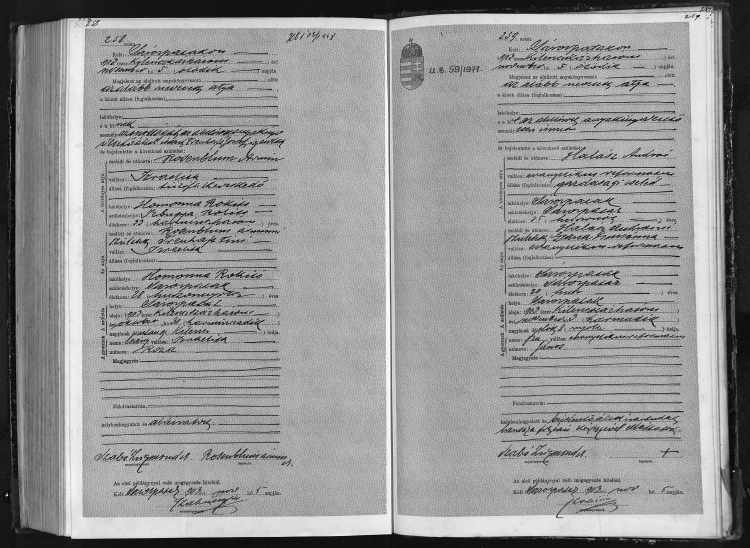
Rossa’s birth record:
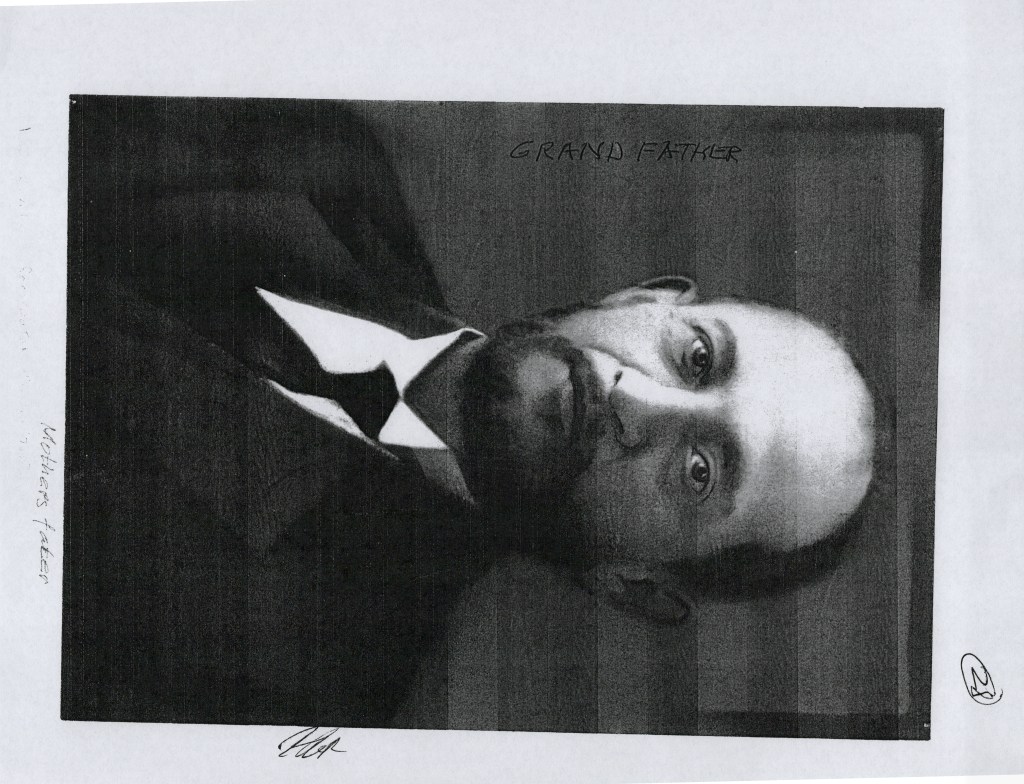

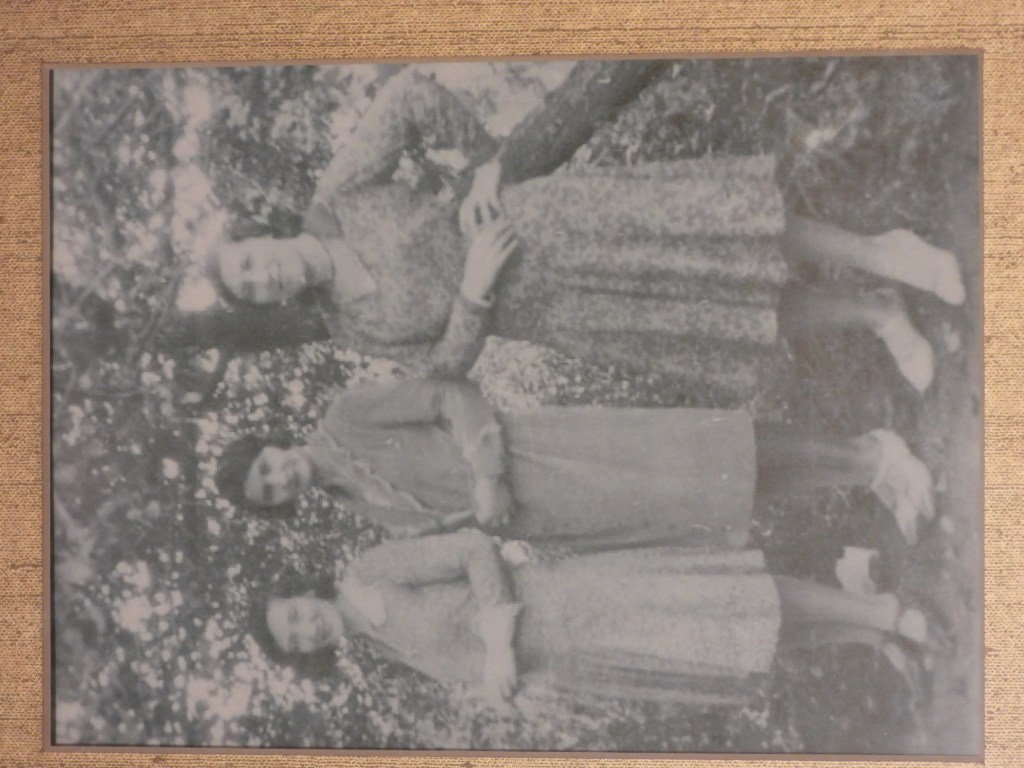
Rozsi (Rachel bas Lea) (1903-1944) married Jeno Weisbluth (Jankev ben Yechiel) (1899-1990) and they moved to Mezocsat.
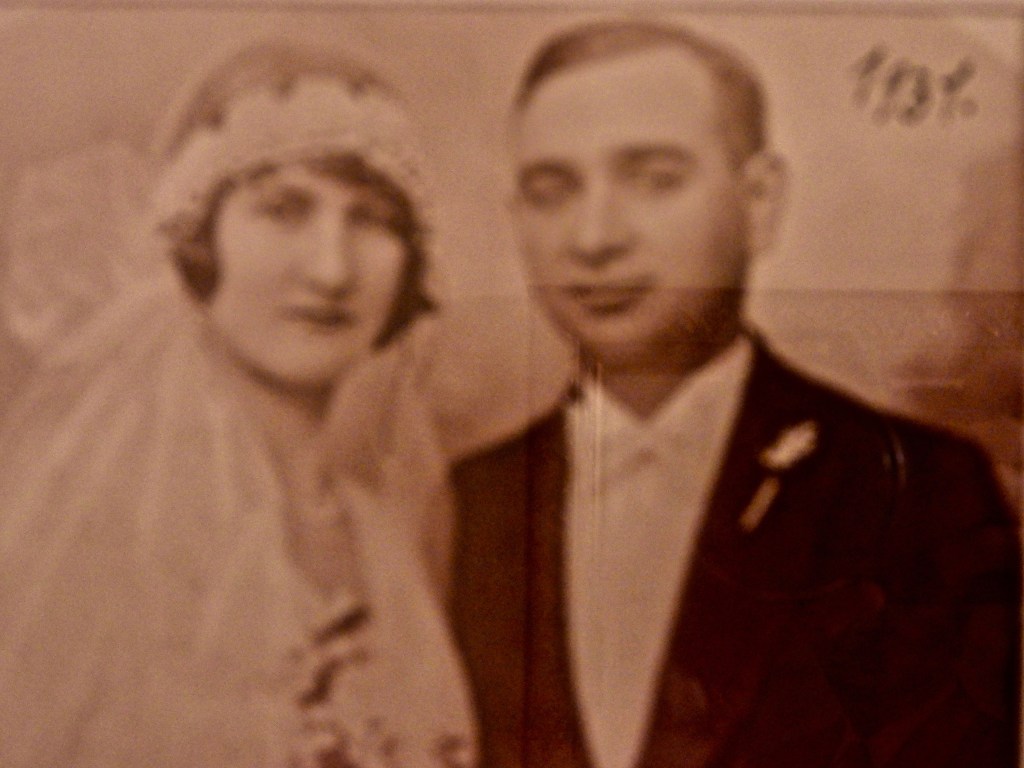
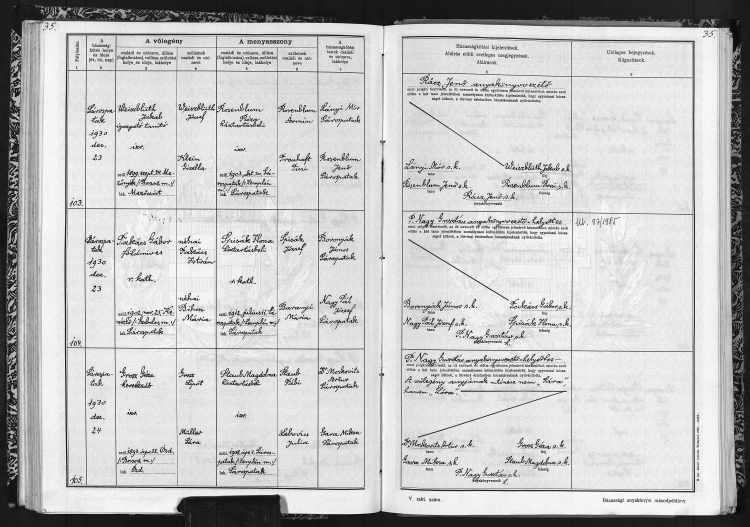
Rosza and Jeno’s marriage record (upper right) follows (note that her brother Jeno was a witness):
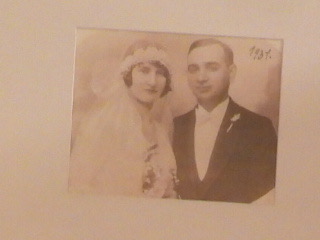
With her dowery, they purchased and furnished a beautiful home with a wonderful library containing more than 2,000 books. Jeno or “Eugene” was the headmaster of the Jewish school in Mezocsat. Rozsi held the family together under very difficult circumstances when her husband was taken for the labor battalions and the government stopped paying her the money Jeno earned as the headmaster of the school. The Jewish community also refused to help her. She loved to paint and her eldest child, Tomas, remembered some of her works well enough describe them some 50 years later when he published an offer to purchase them on his first and only visit to his village after he and his family were deported by their fellow Hungarians.
Rozsi and Jeno had five children, Weiszbluth Gyozo Tamas, nick-named Tomi) Tomas (October 2, 1931-2020) (Avrohom ben Jakev), Gyorogy Tivadar (Menachem Mendel ben Jankev) (nick-named Gyuri) (May ___, 1933-1944) (who Tomas’s son, Michael George Reed, was named after), Oskar Ivan (Arye ben Jankev) (nick-named Oszi) (April ___, 1935-1944) Alfred Denes (Eliezer Zvi ben Jankev) (nick-named Fredi) (June ___, 1937-1944), Juditka (Keile bas Rachel) (nick-named Mucus) (May ___, 1940-1944) (who Tomas’s first born daughter, Judith Roseanne Reed, was named after) and a child she was pregnant with when she was murdered in Auschwitz (1944).
She was an attractive woman, talented amateur painter, pianist, housewife and courageous person.
My father, Thomas W. Reed, always told me that we came from a long line of rabbis. Thanks to MyHeritage.com, we were able to confirm that story. Both Rashi and Rabbi Abraham Joshua Heschel are related through my paternal Grandmother, more particularly, her Aunt.
The Question I asked AI, linking Rabbi Heschel to a known Heschel relative – Is Rabbi Joshua Heschel related to Dinah (the Great) Wahl Katzenellenbogen?
The Answer – Yes, Rabbi Abraham Joshua Heschel (1907–1972) is a direct descendant of Dinah “The Great” Wahl Katzenellenbogen. [1, 2]
Their familial relationship bridges several centuries of elite European rabbinic history:
1. The Maternal Connection & Name Origin
The entire Heschel rabbinical dynasty actually traces its surname and lineage directly back to Dinah’s immediate household. Dinah Katzenellenbogen (c. 1610–1664), renowned as “The Great” for her profound scholarship in Jewish Law, was the second wife of the legendary Rabbi Abraham Joshua Heschel of Kraków (1596–1663), the Chief Rabbi of Kraków and head of its great yeshiva. This 17th-century sage is the original ancestor from whom the 20th-century civil rights leader and theologian directly inherited his name.
2. Royal and Rabbinic Pedigree
Through Dinah, the Heschel family inherited a staggering lineage of early European Jewish leadership:
- The “King for a Night”: Dinah was the granddaughter of Saul Wahl Katzenellenbogen (1541–1617). According to famous Jewish folklore, Saul Wahl was a trusted royal advisor who was supposedly appointed symbolic “King of Poland” for a single night during an interregnum. “Upon the death of King Stephan Batory in 1586, there was a gap in leadership since a Crown Prince had not been chosen. The Council of Ministers gathered in Warsaw to elect a new king, but could not make a decision during the time allotted by law. To buy time they unanimously named the respected Rabbi Saul Wohl as King for one night. As he set on the throne they cheered, “long live the King!” During that night the Rabbi King passed several decrees to benefit the Jewish people. The next day they elected Zygmund the Third as King of Poland.
- The Sages of Italy: Saul Wahl was the son of Rabbi Samuel Judah Katzenellenbogen, and the grandson of Rabbi Meir Katzenellenbogen (the Maharam of Padua) (1482–1565), the founder of the lineage and one of the preeminent halakhic authorities of the Italian Renaissance. He was the direct ancestor of the Noda B’Yehuda, Rabbi Yechezkel Landau. R’ Meir was known as the MaHaRash. An interesting note: Meir was the grandfather of the famous Abraham Yehoshua Heschel, and Meir’s brother Judah Wahl was the grandfather of the wife (Dina Wahl) of Abraham Yehoshua Heschel. This meant that the two second cousins married. Meir married in 1585 to Heinda Horowitz of Cracow. The following information concerns Heinda’s distinguished lineage: She was the niece of the REMA, Rabbi Moshe Isserlis. Heinda’s father was Rabbi Pinchus Horowitz (1535 Prague – 1618), and her mother was Miriam Baila Isserlis (died 1617) a sister of the Rema, and the daughter of R’ Yisorel Isserlin (spelled this way for some reason) of Cracow. Heinda’s paternal grandparents were R’ Yisroel Horowitz (1500- 1572 Prague), and Ortilla Stern (1507 – 1572 Prague). Heinda’s paternal great-grandparents were R’ Aaron Meshulim Zalman Horowitz (1470 – 1545 Prague), and Necham Munk (1486 – 1536). Heinda’s paternal great-great-grandparents were R’ Isiah HaLevi Horowitz (1465 Horowice, Czech – 1517 Prague), and Rivka Yomtov Heller (died 1515 Prague).
This elite lineage passed down from generation to generation, eventually giving rise to the Apter Rov (the Ohev Yisrael), and ultimately connecting Dinah “The Great” as a distant maternal ancestor to Rabbi Abraham Joshua Heschel. [1]
If you want, we can map out how this lineage transitions from the 17th-century Kraków Rabbis into the 18th-century Hasidic movements, or explore the legendary story of Saul Wahl Katzenellenbogen.
The Jewish Journey: A Passage Through European History …
Yissachar Ber of Cracow (Pres. of the Four Lands Council) was the son of Chief Rabbi Abrahan Joshua Heschel, direct descendant of …


MyHeritage
Dina Katz Heschel Family History & Historical Records
Dina Katz Heschel, “haGedolah” (born Wahl Katzenellenbogen), “haGedolah” was born in 1610, in birth place . Dina married Abraham J…Avotaynu
Dina (The great) Katz Heschel (born Wahl Katzenellenbogen וואהל-קצנלנבוגן) was born in 1590, in Praha, Prague, to Samuel Judah Katzenellenbogen (Wahl) and Tehila Katzenellenbogen (born dau. Rema Isserles). (the great,for her knowledge of Jewish Law)
Siblings
Dina had 2 siblings: Yeshua Heschel Katzenellenbogen of Krakowand Rebecca (Rivke) Günzburg (born Wahl Katzenellenbogen).
Spouse
Dina married Avraham Yehoshua Heschel (Levenshtam), Head of the Cracow Yeshiva circa 1650, at age 60.
Avraham was born in 1596, in Kraków, Malopolskie, Poland.
They had 12 children: Issachar Dov Berish Heschel Babad Rosh Vaad Arba Aratzot, Esther Shapira (born Heschel), Saul Babad Heschel Lowenstam Teomim, Hesia Heilprin (born Heschel), Karindel Feiwel ” the rich ” from Viena (born Heschel), Wife of R’ Aharon Zvi Hirsch HaKohen (born Heschel Lowenstam), Yehudah Judah Leib Heshel Levenshtam ABD Amsterdam, Samuel Mordecai Heschel Levenshtam, Ite Hecht (born Heschel), Grune Ashkenazi ? of Opatow (born Levenshtam Heschel העשיל), Sarah Megeza-Zvi Ashkenazi-Magenza (born Heschel Levenshtam) and Eliezer Heschel Babad Landau ABD Dubno.
Dinathen married Naftali Hirsch Katz, ABD Lublin, “Peirot Genosar” circa 1650, at age 60.
Naftali was born circa 1588, in Prague, Czechia.
They had 3 children: Perl Zanvil Bachrach (born Heschel) and 2 other children.
Death
Dina passed away in 1664, at age 74 in Lubelskie, Poland.
She was buried in Brody, Brodivs’kyi district, Lviv Oblast, Ukraine.

DNA
The Y-DNA Genetic Signature and Ethnic Origin of the …
Mar 7, 2016 — Although he shares the Katzenellenbogen surname with the pedigreed Katzenellenbogen descendants, and he undoubtedly shares a commo…

Show all
Here is the generational map showing how the lineage transitions from the elite, rationalist rabbinical courts of 17th-century Poland down into the 18th-century Hasidic movement, ultimately leading to the 20th-century theologian Rabbi Abraham Joshua Heschel.
👑 The Renaissance & Kraków Roots (16th–17th Century)
The family begins as the pinnacle of European rabbinic authority (Misnagdim/pre-Hasidic elite), centered around the Katzenellenbogen and Wahl dynasties.
- Rabbi Meir Katzenellenbogen (The Maharam of Padua) (1482–1565)
Preeminent Halakhic authority of Italy. - Rabbi Samuel Judah Katzenellenbogen (1521–1597)
Chief Rabbi of Venice. - Saul Wahl Katzenellenbogen (1541–1617)
The legendary “King of Poland for a Night” and royal advisor. - Dinah “The Great” Wahl Katzenellenbogen (c. 1610–1664)
Married Rabbi Abraham Joshua Heschel of Kraków (1596–1663), one of the greatest Talmudists of Poland. From this marriage, the family carries the “Heschel” name forward.
✡️ The Transition to Hasidism (18th Century)
As the mystical Hasidic movement swept through Eastern Europe in the 1700s, the descendants of the Kraków rabbinate embraced it, marrying into the inner circles of the movement’s founders.
- Rabbi Issachar Berish Heschel (d. 1690)
Son of the Rabbi of Kraków; served as Rabbi of Brest-Litovsk. - Rabbi Abraham Joshua Heschel (d. 1744)
Rabbi of Brody, Ukraine. - Rabbi Meshullam Feivush Heschel (d. 1765)
Rabbi of Zbarazh. His children fully integrated into the rising Hasidic wave. - Rebbe Avraham Yehoshua Heshel (The Apter Rov / “Ohev Yisrael”) (1748–1825)
Great-grandson of the Rabbi of Brody. He became the premier disciple of early Hasidic masters and founded the Apt-Mezhbizh-Zinkover Hasidic dynasty.
🕊️ The Hasidic Dynasts (19th Century)
The family establishes its own holy dynasties in Ukraine, strictly marrying into other elite Hasidic lines (like the Chernobyl and Rizhin dynasties).
- Rebbe Yitzhak Meir Heschel of Zinkov (1775–1855)
Son of the Apter Rov; expanded the dynasty in Podolia. - Rebbe Meshullam Feivush Heschel of Zinkov (1804–1864)
Maintained the court at Zinkov. - Rebbe Avraham Yehoshua Heschel of Medzhybizh (1832–1887)
Moved the primary family seat back to Medzhybizh, the birthplace of Hasidism.
🗽 The 20th-Century Theologian
- Rabbi Moshe Mordechai Heschel (1873–1916)
A Medzhybizh Rebbe who eventually moved to Warsaw, Poland. - Rabbi Abraham Joshua Heschel (1907–1972)
Born in Warsaw, named precisely after his ancestors. He escaped Europe in 1940, came to America, and famously marched with Dr. Martin Luther King Jr., declaring that his feet were “praying.”


You must be logged in to post a comment.