Herman (Tzvi) Gruenwald (born July 4, 1925 in Nyirmada, Hungary and died on April 29, 2020 in Montreal, Canada [??2021??]), son, brother, husband, father, businessman and author. He immigrated to Canada in 19___ where he built a life in Montreal, Canada. He married Eva Racz (1929-2011) in 19___.
His father was Naftule Yitzchuk (Ignacz) Gruenwald and his mother was Blanka Breindel Gruenwald (born Rosenblum on June 10, 1894 in Saraspotok, Hungary) and they were married in 1921. Blanka died on June 2, 1944 [in Germany?].
Blanka’s parents were Armin Abraham Rosenblum (born in 1865 in Rokito, Hungary) and Taube Leah (Tini) Rosenblum (born Treuhaft) and they married August 21, 1892 in Saros Nagy-Patak,Zemplen County, Satoralja-Ujhelyi District, Austria-Hungary. Armin was murdered in 1944 in [Germany?].
Armin’s father was Mendel Rosenblum and his mother was Roza Rosenblum. Mendel was born in 1845 in Hungary and died in Hungary. His wife, both in Hungary, was the child of _______________ and ________________.
His siblings were Edith (Esther) Biro (born Gruenwald) Kertez (second husband), Alice Weiss (born Gruenwald), Theodore (Tibi (Chaim Shlomo) Wald (born Gruenwald), Kathryn Berger (born Gruenwald) and ________________

They had two daughters, Anita (1956) and Sandy (1958).
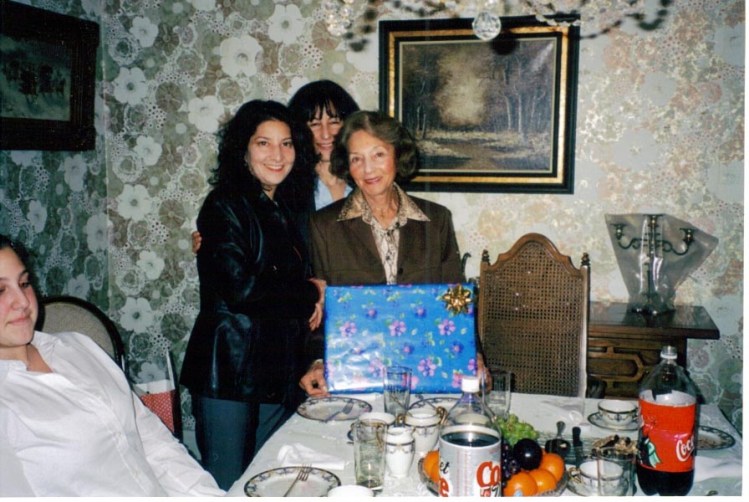
Anita went on to become a school teacher and mother herself to two daughters (Jessica, born in 1984 and Kathryn, born in 1986) after she married Dr. Meyer Balter ( born 1955).
MY TRIBUTE TO HOLOCAUST SURVIVOR
HERMANN GRUENWALD
Hermann is sharing his story with Radio-Canada reporter Anyck Beraud, on life after the liberation of Auschwitz, and how he came to settle in Montreal
Many of us feel we live an ordinary life. But my friend, Hermann Gruenwald, truly lived an extraordinary life. Much of what happened in his life he wouldn’t have chosen, yet there is one thing he did choose: he used his difficult life experiences to strengthen and inspire others. And indeed, he succeeded.
Hermann was one of the very few who survived the deadly Auschwitz and Birkenau death camps. The fact that God granted him the blessing of passing on Yom HaAtzmaut is — to me — a final act of Jewish solidarity in the face of history’s anti-Semites.
There is no doubt in my mind that God spared Hermann with the knowledge he would use his time wisely and to constantly be adding light to the dark world. Hermann served on the board at the International Fellowship of Christians and Jews of Canada as our longest serving member, where he had the ability to help those who had gone through the same living hell he had. His relationship with The Fellowship globally played an indispensable role in bringing on hundreds of thousands of Christian friends of Israel as partners in our work. That is just one accomplishment in a resume filled with notable achievements.
Hermann’s extraordinary life stretched 94 years. He was born in Hungary to a loving family, yet his life with his parents and four siblings came to an abrupt halt in 1944. At just seventeen years old, he and his family were deported to Auschwitz. With great favour, intelligence, and ingenuity, he soon became the only Jewish cook in Auschwitz and Birkenau. He also saved countless lives by secretly trading food for medicine for those who needed it most.

Rabbi Eckstein and Hermann Guenwald
at the IFCJ US 25th Anniversary
He moved to Montreal after liberation, where he became one of the most successful manufacturers in Canada. He wrote his book “After Auschwitz: One Man’s Story” and began a second career in his 70’s speaking to students about his experiences during WWII and in the death camps.
Hermann believed that education was the key to ensuring that the world would never again see such horror. But he didn’t let his life be defined by tragedy. He remained a vibrant, loving, caring, and successful person who gave of himself to help others. Like many survivors, he carried with him terrible memories, yet he still found a way to shine a light even brighter than those adversities.
People like Hermann are the heroes of the Jewish people. Their stories and their inspiration are what get me out of bed in the morning, inspired to make a difference in the lives of folks who have been mistreated and who face injustice. It’s people like him who remind me that everyone is able and responsible to do their best to fix this broken world.
My father, Rabbi Yechiel Eckstein, often acknowledged that whenever we hear of stories from the Holocaust, one of the main questions we ask is, “How did God let this happen?”
It is an age-old question: Why do good things happen to bad people and bad things happen to good people?
“Where was God?” is always our first reaction. It is a legitimate question to ask, but my father also taught me that you also have to ask not simply where was God, but where was man? Because ultimately life is a unique partnership between God and man.
God looks to us, His children, and asks us to fix the things that are broken, to shine light into the darkness, to overcome evil with good. We have the opportunity to be the blessing the world needs.
Hermann did that. He repaired the world. His memory is a blessing to Canada, to Israel, and to the entire world.
With blessings from the Holy Land,
Yael Eckstein
President
By the time Hermann Gruenwald returned to Auschwitz in 2003 to show his granddaughter the place that held him for nearly a year, it had been turned into a museum. When a young woman approached to collect their entrance tickets, Mr. Gruenwald told her, “The first time I came here, I didn’t have to pay.”
Of course he had paid plenty, drawing on reserves of resolve to stay alive. In this currency he was rich. It ensured he would do more than survive – he would thrive.
Mr. Gruenwald died at his Montreal home on April 29. He was 94.
His quip at the entrance to Auschwitz reflected a philosophy that went roughly like this: In order to overcome the worst that life hands you, you have to look ahead to the best it might offer. Don’t forget what happened. In fact, tell anyone who will listen about it. But don’t dwell there.
Mr. Gruenwald was born on July 4, 1925, into a well-to-do family in Rohod, Hungary, a village in a country where, rare for central Europe, Jews were permitted to own land. He was an eldest son, destined to take over his father’s estate.
The story he told most often, which sustained him through three concentration camps and a death march, was how as a teenager he would watch his father’s labourers move shoulder-to-shoulder through fields scything the grain. No matter how skillfully the harvesters cut, he noted that here and there a single stalk of grain remained standing. When he was 18, surrounded by hundreds of men but alone in the darkness of an Auschwitz barrack, the fate of parents and siblings unknown, Mr. Gruenwald told himself he would be that single stalk of grain.
It was a vision that served him well. One of his first tasks was grinding for fertilizer the bones of gas-chamber victims that had not been sufficiently burned in the crematoriums. It was easier to kill people than dispose of them, he noted. Another job was shovelling sand, work that would have finished him off quickly, unaccustomed as he was to this kind of labour.
He schemed his way into the camp’s kitchen, itself a death-defying act of audacity because Jews were forbidden to work there. From this relatively privileged position he supplied food and medicine to others in the camp.
One of these men he met many years later, poolside in Florida, noticing the number on his arm. “I see we were at the same hotel,” Mr. Gruenwald said by way of introduction.
As the war drew to a close, Auschwitz was emptied. His relatively easy life was over. For several January days in 1945, Mr. Gruenwald was among thousands who marched from Poland toward Germany and other camps. Countless numbers froze to death or were shot when they could no longer walk.
In April he was at Gusen II, a place where aircraft were manufactured. By then there was no longer enough food even for the guards, who stole much of what little was given to the prisoners.
There were not enough bowls either. Mr. Gruenwald shared one with four other men. An image that stuck with him: At mealtime each man was allowed five swallows from the bowl, counted by the others who watched his Adam’s apple go up and down. If you took a sixth swallow you might be beaten to death.
Liberation came on May 7.
:format(jpeg)/cloudfront-us-east-1.images.arcpublishing.com/tgam/KI2Q6525B5GZFIS2RU4N6GYBX4.jpeg)
Mr. Gruenwald made and lost a small fortune in the black market in postwar Vienna. He married fellow Hungarian refugee and camp survivor Eva Racz. They arrived in Montreal in 1950, penniless, speaking neither French nor English. His first job was pushing a broom for a furrier. He learned to cut skins – muskrat, beaver, mink, lamb – whatever could be made into a coat. Soon he was making coats in his own business.
When that field became too crowded, he moved into other kinds of manufacturing. In the 1960s and 70s, Montreal still made just about everything the country needed, and Mr. Gruenwald was in the thick of it. He helped introduce pantyhose to Canada, made at his hosiery business. Other workshops made shoes and lampshades, and there was a plant nursery on the city’s South Shore.
His preferred strategy was to buy into an existing business, forming a partnership with the owner. He bought a house in the Snowdon district near the Décarie expressway so that each morning he could hop into his Jaguar to visit his workshops. All but the nursery were located on the way to Reliable Hosiery, his core asset, in the city’s Park Extension neighbourhood.
Reliable was his alone. It was housed in a two-storey factory building with more space than he needed. He sublet the upper floor to a manufacturer of children’s clothing, only to discover to his horror that this company had in turn sublet the premises, in 1968, to an up-and-coming Parti Québécois.
After his experience of fleeing communism and fascism in Europe, nationalist movements were anathema to Mr. Gruenwald. He was not reassured by the October Crisis, in 1970, when heavily armed soldiers turned up on his street to guard the home of a diplomat.
It was not good for business either, as he found in the run-up to the 1972 provincial election. The PQ lost badly, but for weeks before there were demonstrations and media galore outside his factory, which then-premier Robert Bourassa called “the Palace.”
One thing that helped Mr. Gruenwald maintain his equanimity was a wary acquaintance with René Lévesque, with whom he chatted from time to time. In Mr. Lévesque he saw a decent man, the human face of Quebec’s aspirations.
Long after the PQ had moved on from the Reliable building, he ran into Mr. Lévesque at Dorval Airport where they had a drink. In a long-standing joke they shared between them, Mr. Lévesque introduced Mr. Gruenwald to his entourage as “the landlord who overcharged me.”
Mr. Gruenwald’s ambition matched his appetite for risk. When the PQ was elected in 1976, anglophone companies fled the province in droves. Mr. Gruenwald saw opportunity, buying Dominion Corset, a 90-year-old factory in Quebec City.
Renamed Création Daisyfresh, it employed hundreds. The PQ government wanted to keep those jobs in the province, and Mr. Gruenwald was happy to oblige with their help. He was also shrewd enough to sell – to Sara Lee – when he saw the writing on the wall for the Quebec garment industry.
But he couldn’t let go of Reliable. Even as most of the province’s clothing manufacturers moved offshore or gave up, Mr. Gruenwald computerized and automated his plant. He competed with China to sell to Walmart on the thinnest of margins. Nearing 90, he travelled to Europe where he hooked up with an NGO that promoted the use of fair-trade cotton from Africa, hoping this would give him a marketing edge. His survival instinct was still strong.
You cannot be as active in business as Mr. Gruenwald was without making a few enemies. In Montreal’s tight-knit Jewish business community, there were grumbles about how he did a deal. But there was no taint of scandal or wrongdoing.
Among his employees, he won fierce loyalty, in part because he hired mostly women in his front office and put them in positions of responsibility before it was commonly done.
His strongest attachment was to his family – his wife, Eva, who died in 2011, and his daughters, Anita and Sandy. There was also a special closeness with his siblings – against the odds, all four had survived the camps. They were of the right age to have been picked for labour, unlike their parents who were murdered.
In addition to his daughters, he leaves his two granddaughters, Jessica and Kathryn Balter, and a large extended family.
Mr. Gruenwald’s ties to his Jewishness were tenuous before and after the Holocaust. But with the birth of his daughters, he grew closer to his roots, giving generously to his synagogue and causes connected to the Jewish community.
One of the most recent was funding for Château B’nai Brith, a new seniors’ residence in Montreal. The kitchen there will be named in his honour.
A kitchen saved him, and now he has returned the favour.
Bryan Demchinsky is the author of After Auschwitz: One Man’s Story, an as-told memoir of Herman Gruenwald’s life, published in 2007 by McGill-Queen’s University Press.
 Our Family-Our History
You must be logged in to post a comment.