Erica Taubner, only child of Jozsa Taubner (nee Kovacs) (born February 24, 1906) and Zoltan Taubner (born April 27, 1901), was born on August 29, 1932 in Budapest, Hungary where her father owned a store. On March 17, 1944, Nazi Germany occupied Hungary. Her father had to close his retail store and enter a labor camp to work for Hungarian Shell Oil. Erika and her mother hid by day in their Budapest apartment. On one occasion, Erik removed he yellow star and went out to an ice cream store to buy ice cream in a pastry shop. Life became even more perilous after the racist leader Ferernc Szalasi become head of state in October 1944.
Erika Taubner was born six months before Adolf Hitler rose to power. She remembers hearing Radio Free Europe as a young child, and hearing grown-ups discuss distress, and when her father went to work at a forced labor camp for Shell Oil Refinery. By June 1944, laws mandated where Jews could live, and she and her mother joined three other Jewish families crammed into four rooms, including a kitchen and bathroom. Missing were her grandfather, aunts and cousins. They were somewhere, we didn’t know where, but by that time they were nowhere – I guess in heaven,” she said. The next month, Jews could go out on the streets only two hours a day, and only to buy food. “Because I was under the age of 12, I was allowed 2 ounces of milk a week – can you imagine how much is 2 ounces of milk?” she said. “That was the only nourishment. … And we couldn’t go to a theater, we couldn’t go to a movie, we couldn’t go to shop for clothes.” She didn’t much like being holed up as an 11-year-old, she said. But the first time she acted like a child could have been her last.
“I took off my yellow star, I didn’t tell a soul, and I went out. And two houses down was a pastry shop that sold ice cream. I went there, I bought myself an ice cream cone, and I ate it, and then I went home. And obviously, nobody saw me, or they could have actually shot me on sight. … That was my only rebellion all through that horrible time, so I guess I have to forgive myself.”
She never told the story until her parents died in the United States. But it upset her grandson, who wondered where he’d be if she’d been shot. “At that point, I was 11; I wasn’t thinking about him. I wasn’t even thinking of myself.”
With a regime change in October in Budapest, Erika’s mother narrowly escaped registering with the new government, and the two moved to a factory to sleep on the stacks of uniforms they were making, “buttons and all.”
They received Swiss papers that offered them some protection, Her mother sent false government papers, dated Nov. 14, to her father when she received word he’d be removed from the forced labor camp; a dim-witted guard honored the papers and let him off the train en route to a concentration camp, but Erika’s mother lost track of him then. No number of papers could stop the Nazis from raiding the uniform factory Dec. 1, removing 300 women and children on trucks and on foot. When the caravan stopped, all were commanded at gunpoint to stay on board. But Gold, her mother and another woman jumped off anyway, dropping their starred raincoats to reveal non-starred winter jackets. “We were the only three who stayed alive from that 300 group,” she said. They found shelter for six weeks, penned up in their housekeeper’s apartment. Jews in Budapest continued to hear promises of Russian liberation until Jan. 15, when it finally happened.
“It took them three days to get to the ghetto – at that point we didn’t know there was one,” Gold said. “And it turned out that my dad was there.” Upon returning to their apartment, Gold’s family found all the windows but one blown out from air raids. Her parents dragged a sofa into the bathroom, and she slept in the bathtub.
The Russians and neighbors weren’t kind, she said, and her family moved to Cuba for two years while their American visas were approved.
In 1950, they moved to Cleveland, where her mother had siblings, and Gold, then 16, re-entered school at a sixth-grade level. She graduated from Heights High School in 1952 and earned a degree in medical technology from Western Reserve University, marrying Richard Gold that year. Together, they had two children, Marilyn and Allen, who they raised in Cleveland, Ohio. Religion was and is an important part of their lives. Marilyn and Allen went to a religious school until transferring in their later years to Beachwood High School. It was there that Marilyn met her future husband, Joel Zaas. Now Joel and Marilyn have three children of their own (Stuart, married to Leah Joffe Zaas; (Saree, married to Ben Kweller; and Daniel. Stuart and Leah have started a family of their own with the birth of a daughter, London.

Erika Taubner Gold was just five years old when she received this clover charm from her grandmother in Hungary in 1937.
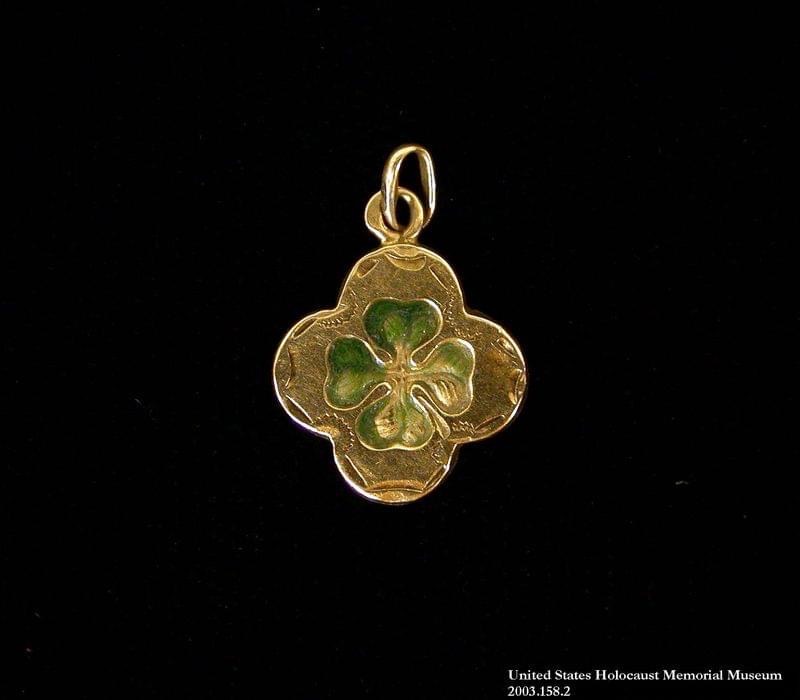
Seven years later, after the Germans occupied Hungary, Erika’s parents sensed the looming danger for Hungarian Jews and decided to bury the clover charm along with other valuables in the dirt basement of their apartment.
Soon after, Erika and her family were forced to vacate their home. Erika’s father, Zoltan, was taken for forced labor service. To avoid deportation, Erika, only 12 years old, and her mother, Jozsa, took jobs working in a factory making soldiers’ uniforms. They lived in the factory and slept on top of the uniforms they made. In December 1944, the Nazis raided the factory, loading all the workers onto trucks.
Erika remembers, “It was a Friday, and it became dusk at about five o’clock in the afternoon. We arrived to this big marketplace … . Then the Nazis said, ‘We’re going to stop here, and nobody get out of line or get off the truck.’ The truck stopped, my mother jumped off the truck and winked at me. I jumped after her, and we walked away.” They managed to vanish in the crowd and find refuge with a former housekeeper., Ilonka Takats. They later learned that everyone who stayed on the truck died at the Auschwitz concentration camp.
The two safely escaped and found shelter with their former housekeeper. In January 1945, Erika and Jozsa reunited with Zoltan, and the family returned to their apartment building. There they found the clover charm and other prized possessions, which were still hidden in the basement. (caption and commentary from the United States Holocaust Museum)
Below please see picture of engraved gold ring given to Erika Taubner, 5, by her paternal grandmother, Katie Taubner, in 1937 in Budapest, Hungary.

Her parents Jozsa and Zoltan later buried the ring, her charm and other valuables in May 1944 in the dirt basement of their apartment, beneath the storage locker of the non-Jewish building superintendent, so they would not fall into German hands. The items were recovered by Erika and her parents in 1945.
Erika’s mother also wangled diplomatic papers and sent them to her husband.
Erika and her Mother were in Pest which was liberated by the Soviet Army on January 15, 1945, and three days later, Erika and her mother rediscovered her father, Zoltan. They found their old apartment intact, though with no utilities and just one window pane. They learned that 44 members of her extended family were killed in the Holocaust.
The family sought a visa to the United States in vain. They finally emigrated to Cuba in 1948 and reached Cleveland two years later.
As a child in German-occupied Hungary, Erika, like all Jews, was forced to wear the yellow star of David. Her father was forced to close his retail store and work in a labor camp. She and her mother worked in a factory, making soldiers’ uniforms.
She and her mother eventually went into hiding with a former housekeeper until being liberated by Russians and subsequently reunited with her father.
Erika Taubner was born in Budapest, Hungary, in August 1932, six months before Adolf Hitler rose to power.
She remembers hearing Radio Free Europe as a young child, and hearing grown-ups discuss distress, and when her father went to work at a forced labor camp for Shell Oil Refinery.
By June 1944, laws mandated where Jews could live, and she and her mother joined three other Jewish families crammed into four rooms, including a kitchen and bathroom. Missing were Gold’s grandfather, aunts and cousins.

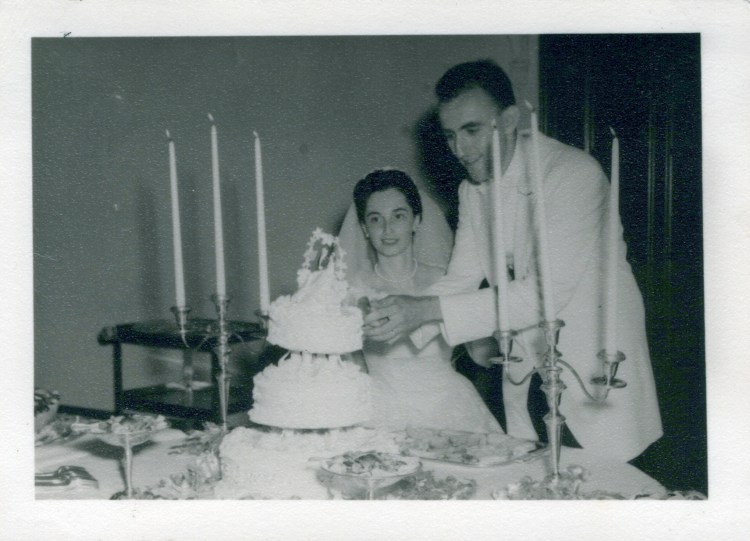
Erika was a friend of Lora Gold Reed and Lora introduced her to her brother, Richard “Dick” Gold. They fell in love and married on ________________.

 Our Family-Our History
You must be logged in to post a comment.